
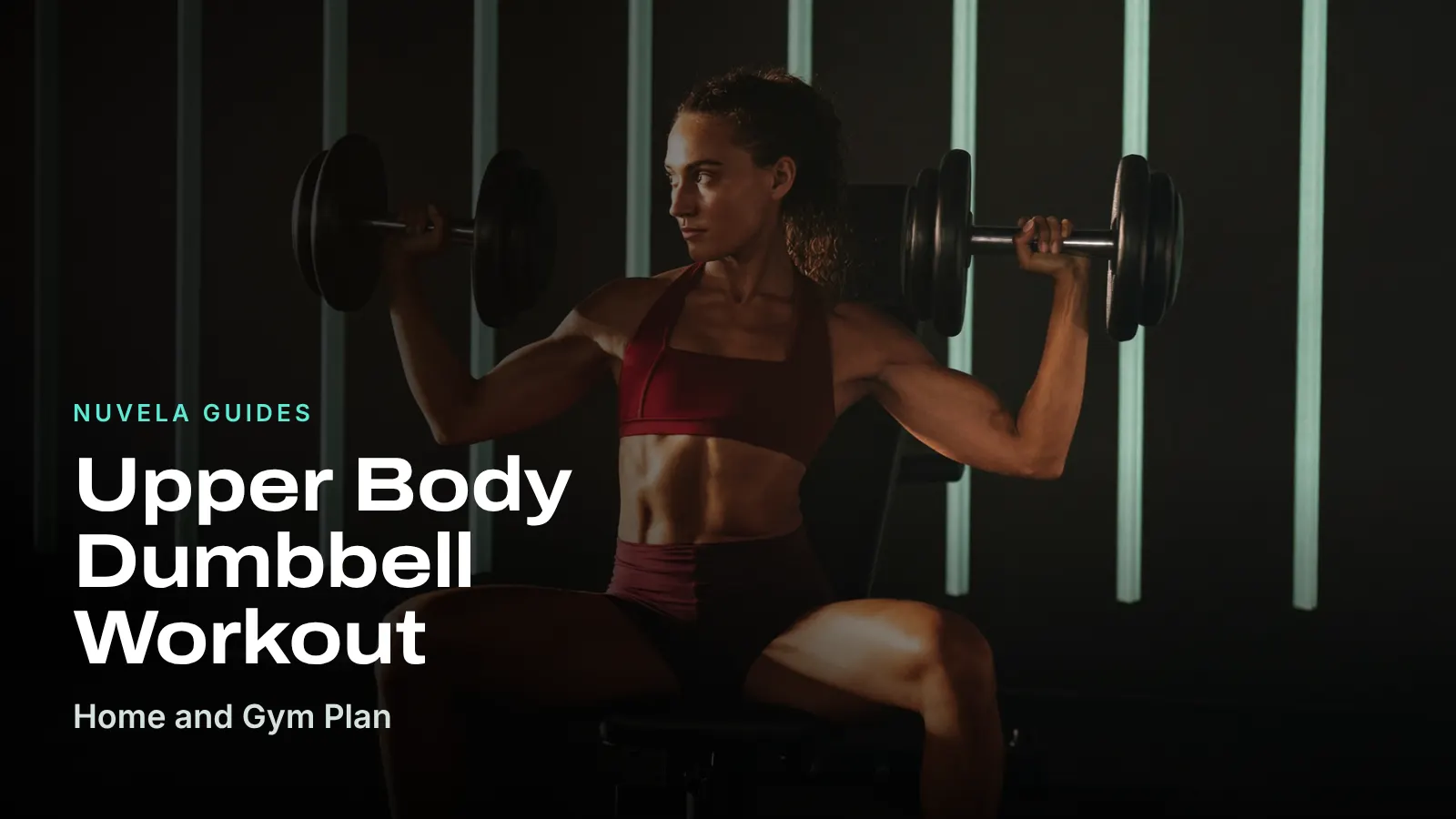
A good upper body dumbbell workout alternates pushing and pulling: a chest press, a row, an overhead press and a second row, then shoulders and arms. Run it twice a week with 3 sets of 8 to 12 reps on the big moves. Below are a home version for one pair of adjustable dumbbells, a faster gym version with paired sets, weights, swaps, form cues and a sample week.
Get an upper body day that fits your dumbbells. Snap your gear and build your week: Nuvela picks the moves, sets the weight for every set and adjusts it as you log. Get Nuvela on Google Play.
How often
Twice a week
On its own days or as the upper half of an upper lower split.
Home
Straight sets
About 50 minutes, 19 sets.
Gym
Paired sets
About 40 minutes, 22 sets.
Order
Push, then pull, then small moves
Big presses and rows first, arms last.
Triceps
Overhead extension
Overhead on purpose.
The plan
One upper body session, about 50 minutes at home or 40 at the gym, done twice a week. It covers chest, back, shoulders and arms. Two sessions give your back 12 hard sets a week, above the 10 weekly sets the 2026 ACSM position stand links with more muscle growth.
Chest gets 6 direct sets plus the overhead press; for more, add 2 sets of push-ups at the end. Run it on its own days, or as the upper half of an upper lower split.
Rules that make it work:
- Push, then pull, then small moves. Big presses and rows go first, arms last.
- Rest about 90 seconds on big moves. A 2024 meta-analysis found a small benefit to resting more than 60 seconds, and no clear gain past 90.
- End each set with 1 to 3 reps left. Lower each rep for about two seconds.
- Same moves for 4 to 6 weeks so you can add weight to them.
Home version: one pair of adjustable dumbbells
You need adjustable dumbbells and a bench or sturdy chair. Straight sets: finish all sets of one move before the next, so you change the dials once per move.
| # | Exercise | Sets × reps | Rest |
|---|---|---|---|
| 1 | Flat dumbbell press | 3 × 8–10 | 2 min |
| 2 | One-arm dumbbell row | 3 × 8–12 each side | 90 s |
| 3 | Seated overhead press | 3 × 8–12 | 90 s |
| 4 | Bent-over two-dumbbell row | 3 × 10–12 | 90 s |
| 5 | Lateral raise | 3 × 12–15 | 60 s |
| 6 | Dumbbell curl | 2 × 10–12 | 60 s |
| 7 | Seated overhead triceps extension, one dumbbell | 2 × 10–12 | 60 s |
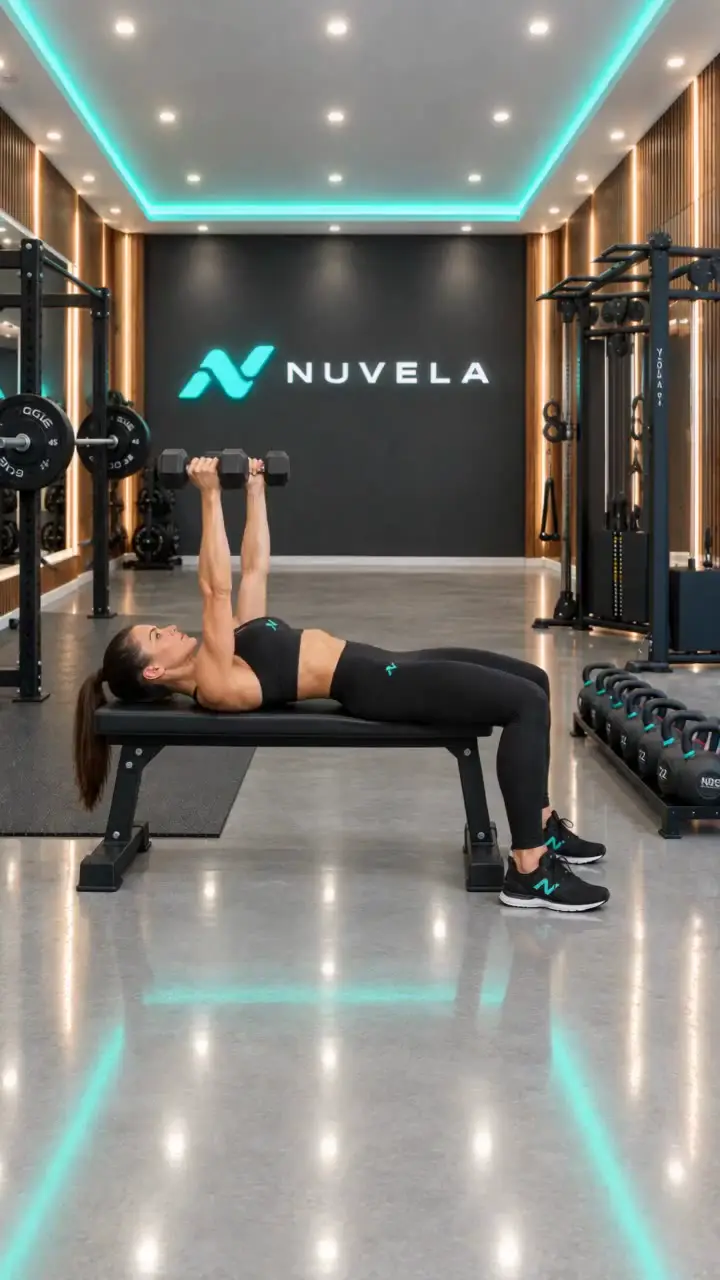
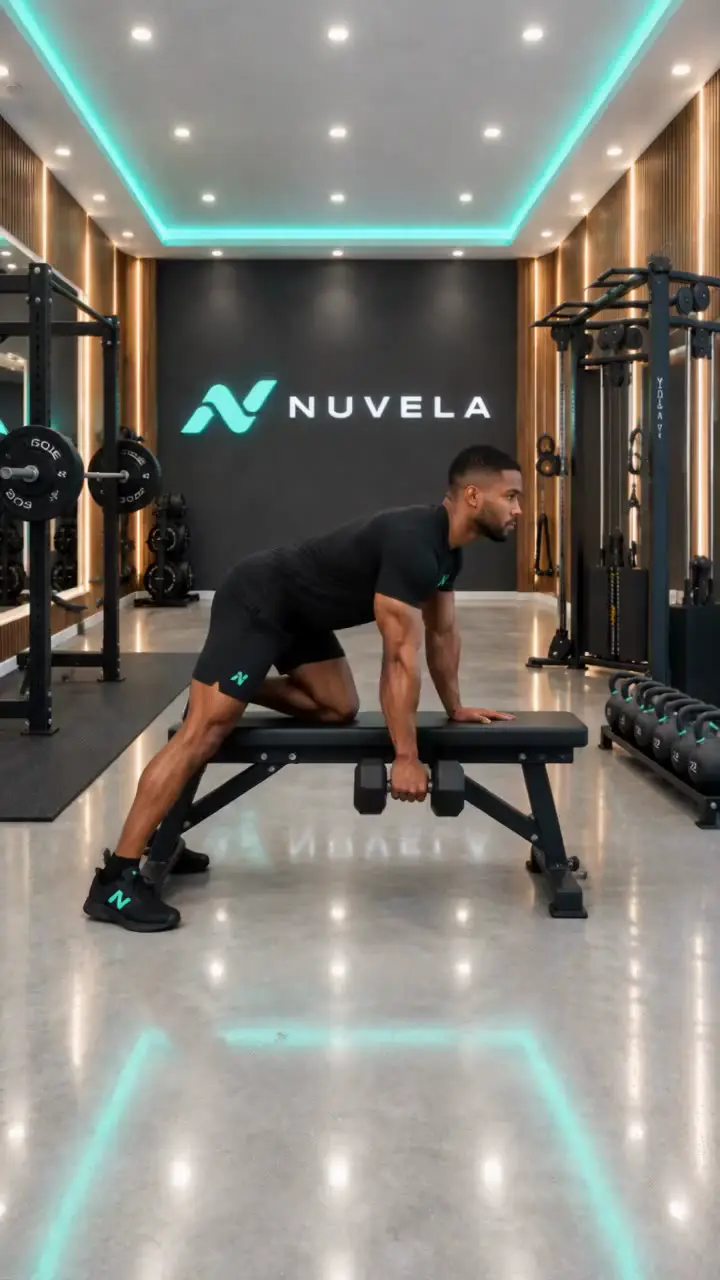
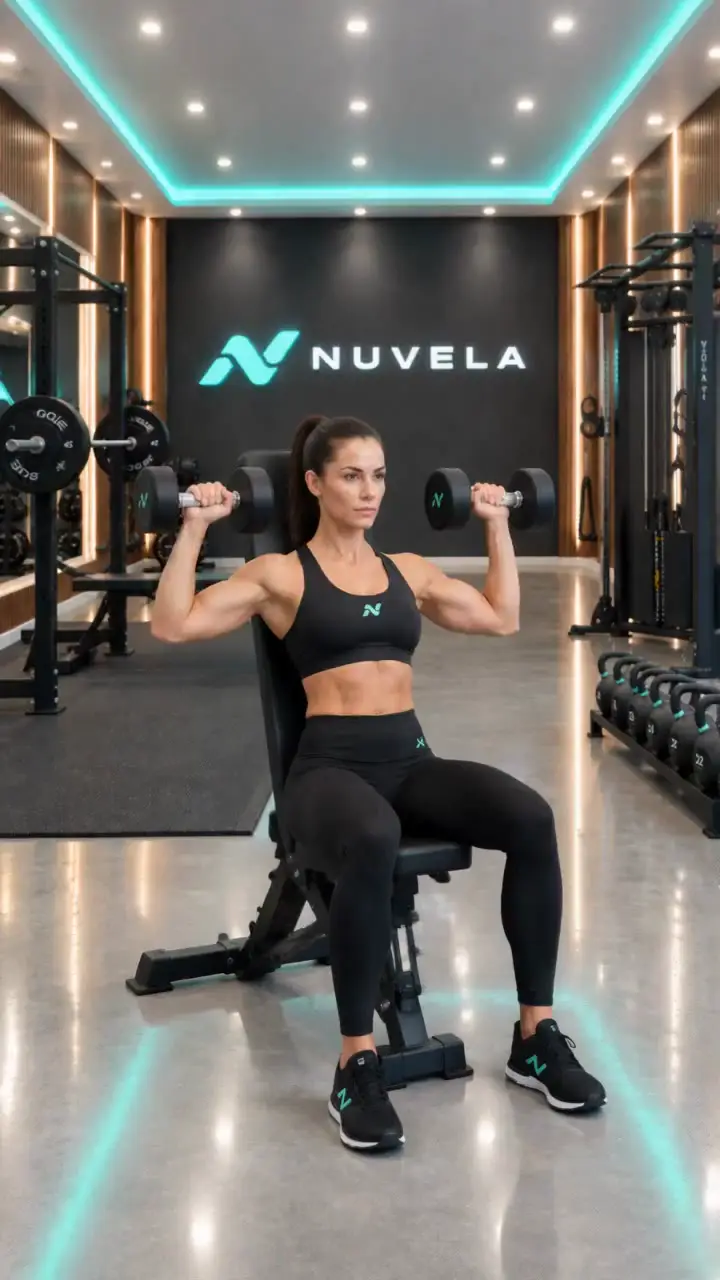
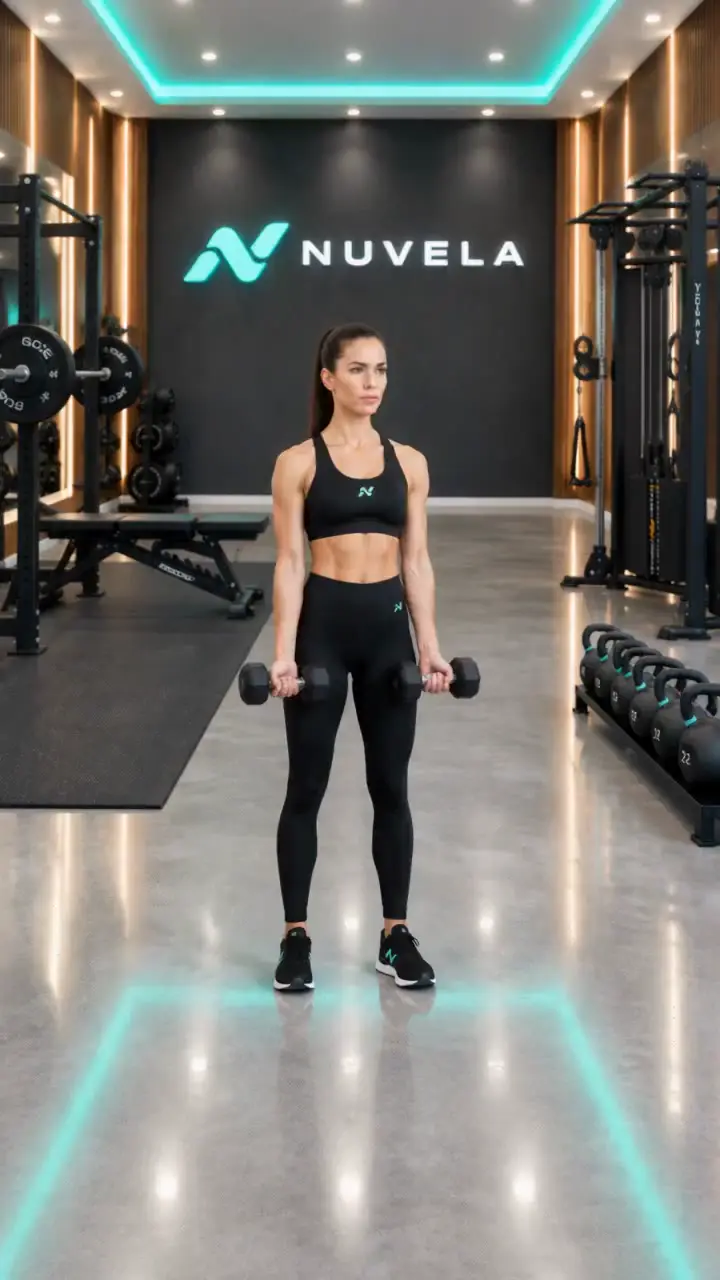
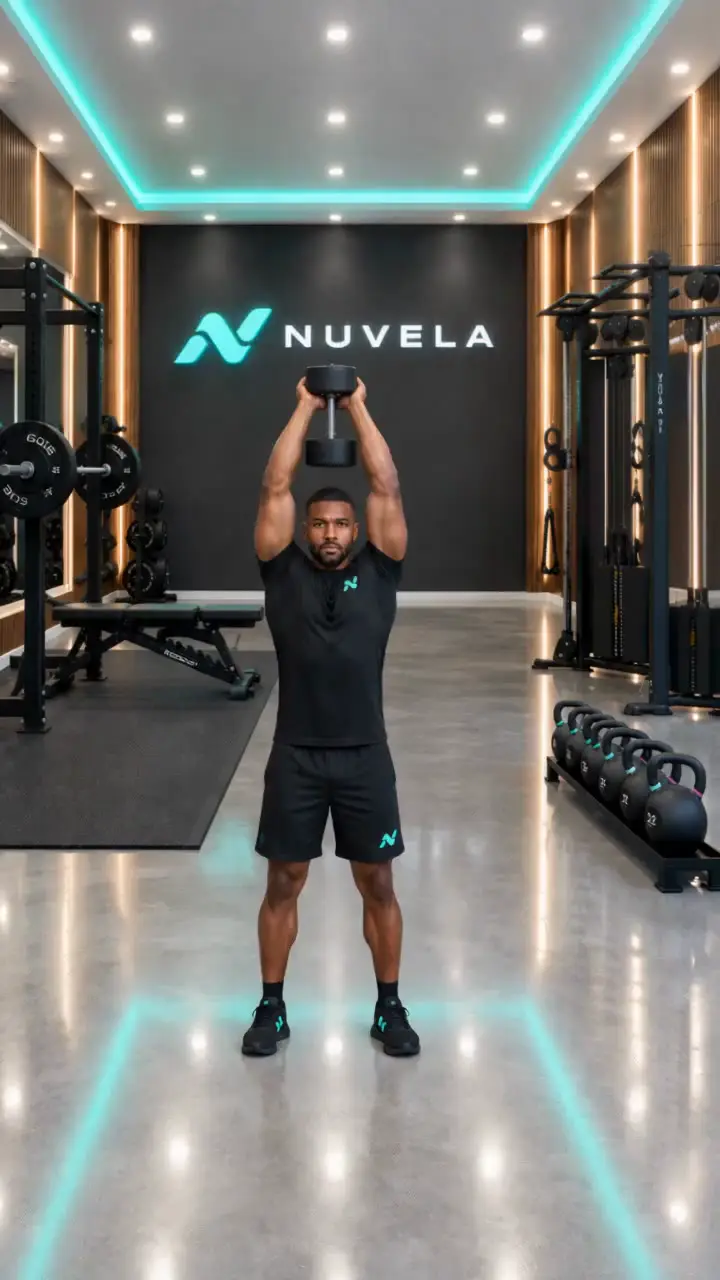
That's 19 sets: the dumbbell bench press, one-arm dumbbell row, seated dumbbell shoulder press, dumbbell lateral raise and dumbbell curl, plus a bent-over row and an overhead extension.
Gym version: paired sets with a full rack
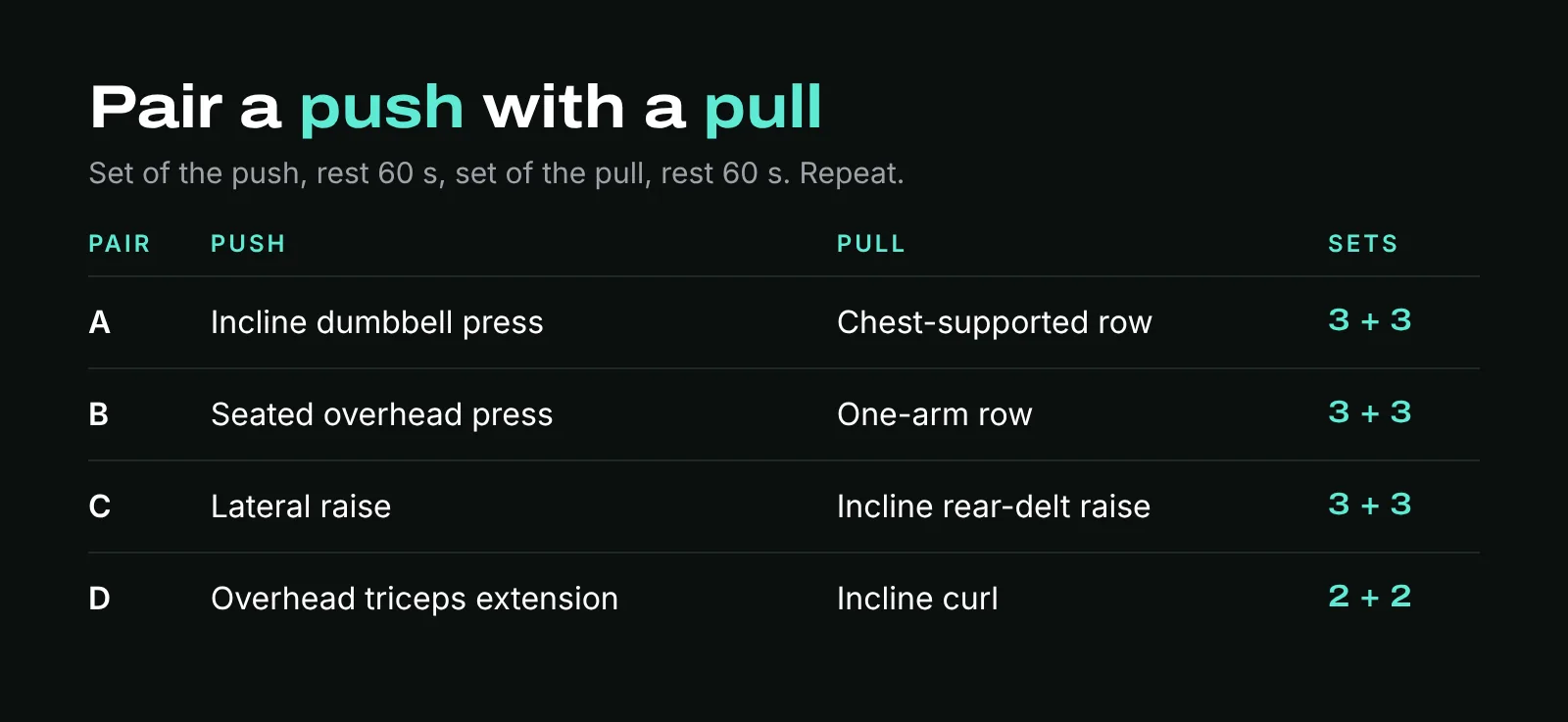
At the gym, grab two pairs and alternate a push with a pull. Do one set of the first move, rest 60 seconds, one set of the second move, rest 60 seconds, and repeat. Each muscle still gets about two minutes between its own sets.
Good
- 22 sets in about 40 minutes
- Each muscle still gets about two minutes between its own sets
Keep in mind
- You need two pairs of dumbbells at once
- Busy gym? Straight sets with 90 seconds of rest take longer
| Pair | Exercise | Sets × reps | Rest between moves |
|---|---|---|---|
| A1 | Incline dumbbell press, bench at 30° | 3 × 6–10 | 60 s |
| A2 | Chest-supported dumbbell row | 3 × 8–10 | 60 s |
| B1 | Seated overhead press | 3 × 8–10 | 60 s |
| B2 | One-arm dumbbell row | 3 × 10–12 each side | 60 s |
| C1 | Lateral raise | 3 × 12–15 | 45 s |
| C2 | Incline rear-delt raise | 3 × 12–15 | 45 s |
| D1 | Incline dumbbell curl | 2 × 10–12 | 45 s |
| D2 | Overhead triceps extension, one dumbbell | 2 × 10–12 | 45 s |
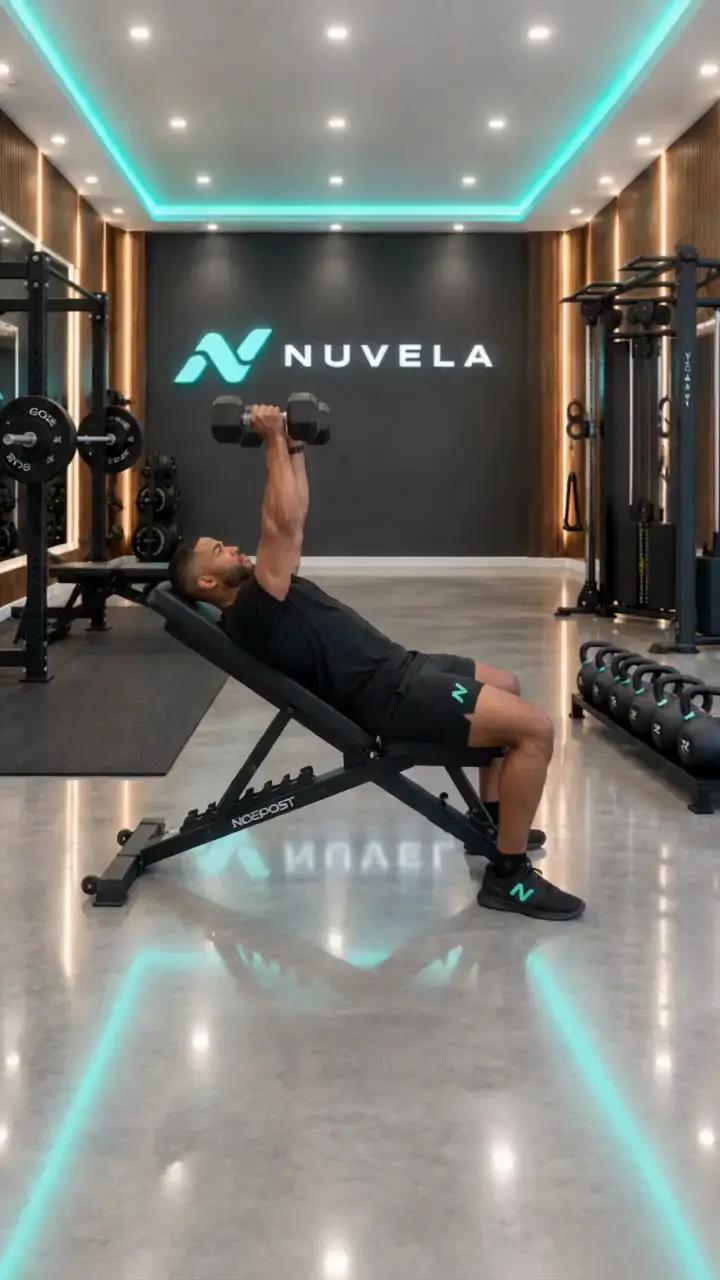
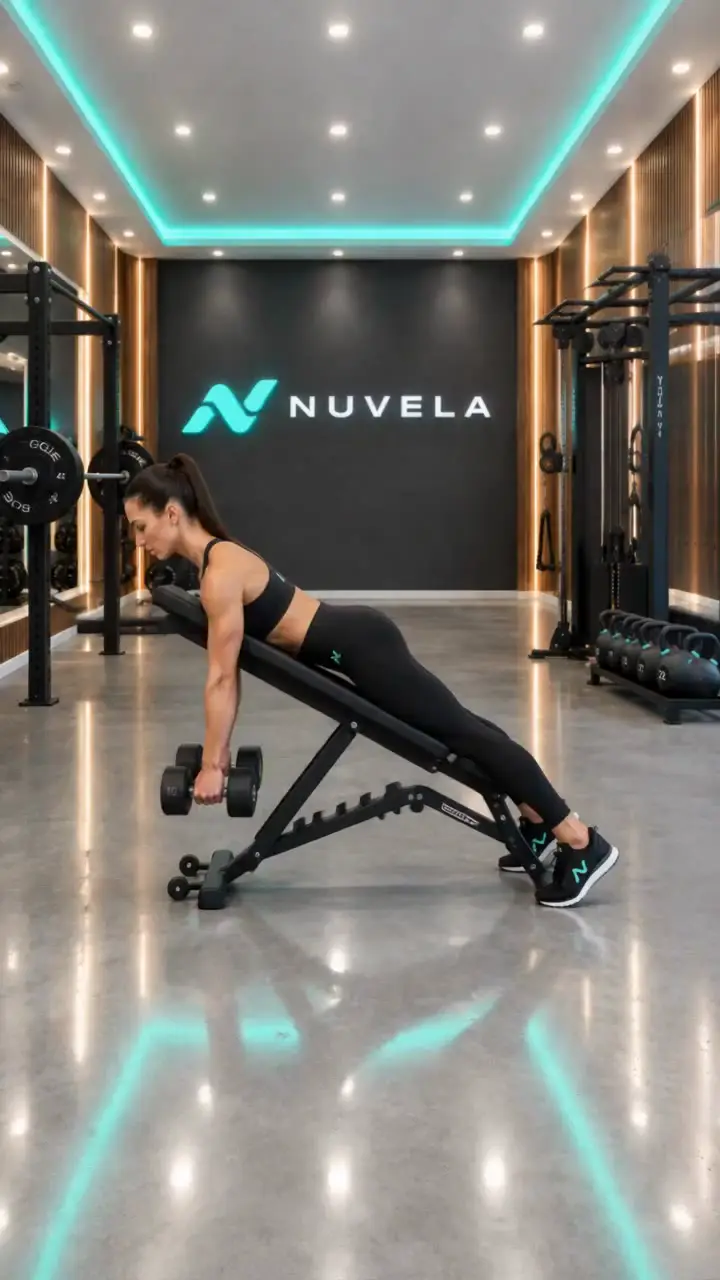
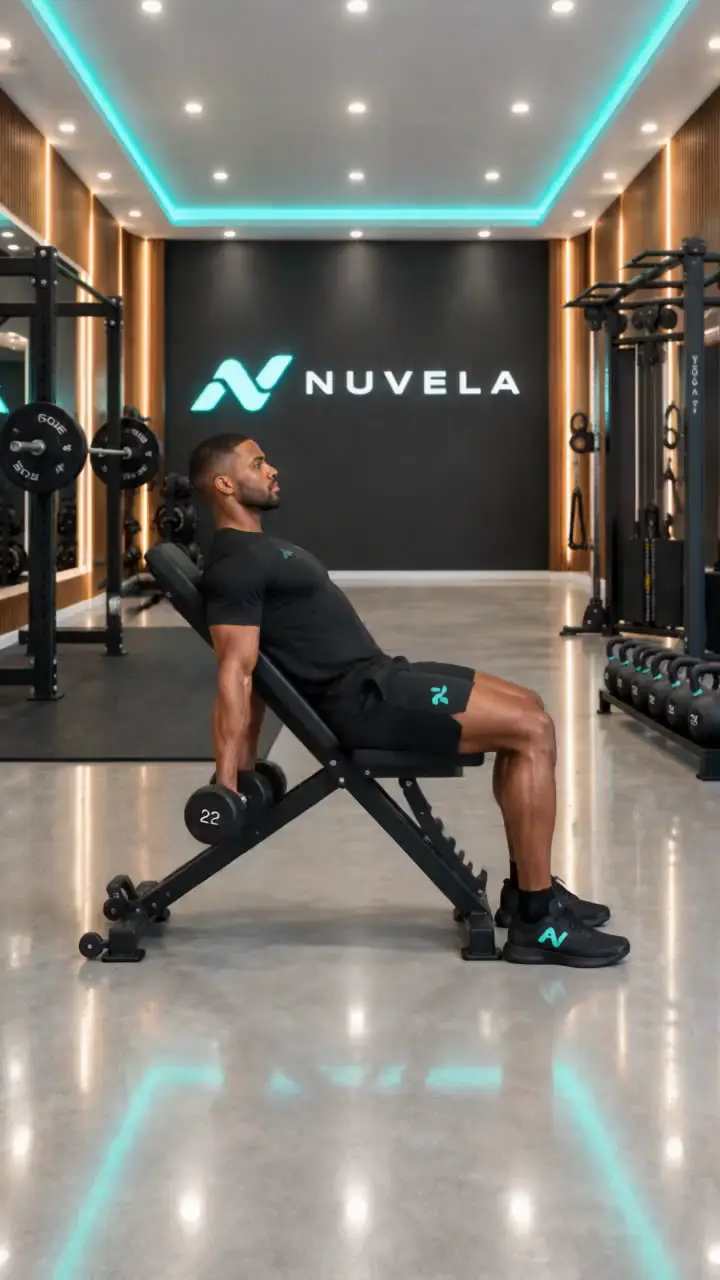
That's 22 sets in about 40 minutes, led by the incline dumbbell press and finished with the incline dumbbell curl. Busy gym? Do the pairs as straight sets with 90 seconds of rest; it just takes longer.
The triceps move is overhead on purpose. In a 2023 study, overhead cable extensions grew the triceps 19.9% in 12 weeks, against 13.9% with the arms at the sides. More triceps options are in our tricep exercises with dumbbells guide.
Get this week built for your gym.
Plan your workout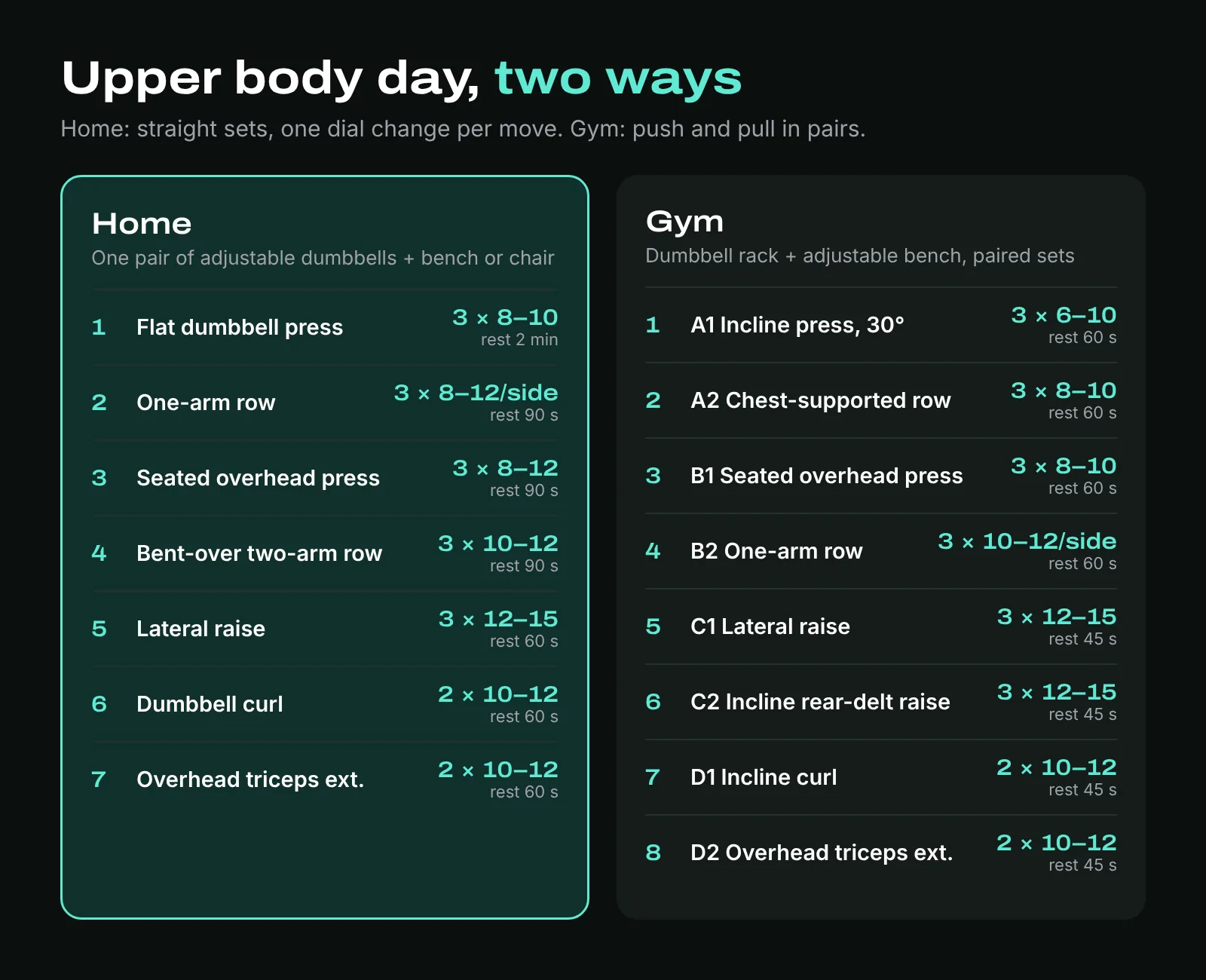
How to pick the weight for an upper body dumbbell workout
Each move needs its own weight. A rough order from heaviest to lightest for most people: rows, flat press, incline press, overhead press, curls and triceps extensions, then lateral raises.
Find your starting weight for each move in the first session:
- Pick a weight you think you can lift 12 times.
- Do one set. If you could clearly do 4 or more extra reps, go up. If you couldn't reach 8 with good form, go down.
- Write it down.
Coming from a barbell? Expect less. In a 2011 study, the dumbbell press max was 17% lower than the barbell max, while chest and front shoulder activity was the same. If you bench 135 lb (61 kg) for 8, try about 55 lb (25 kg) per dumbbell. Not sure what your max is? The one rep max calculator turns a recent set into a number you can plan from.
Typical starting weights
A first guess for someone with a few months of training. Adjust after the first set.
| Move | Newer lifter, per dumbbell | Experienced lifter, per dumbbell |
|---|---|---|
| One-arm row, 3 × 10 | 25 lb (11 kg) | 60 lb (27 kg) |
| Flat dumbbell press, 3 × 8–10 | 20 lb (9 kg) | 60 lb (27 kg) |
| Seated overhead press, 3 × 8–12 | 15 lb (7 kg) | 40 lb (18 kg) |
| Curl, 2 × 10–12 | 12 lb (5 kg) | 30 lb (14 kg) |
| Lateral raise, 3 × 12–15 | 8 lb (4 kg) | 20 lb (9 kg) |
From the second session on, let your last set decide:
| Last set | Next session |
|---|---|
| Top of the range on every set, 1–2 reps left | Add the smallest step, 2.5 to 5 lb (1 to 2 kg) per dumbbell |
| Inside the range | Same weight, aim for 1 more rep per set |
| Under the range | Go down 5 lb (2 kg) and build back up |
| Form broke before the last rep | Pick a lighter weight |
Swaps for every upper body move
If you don't have the gear, or a move doesn't feel right, use the swap. Keep the same sets and reps.
| If you planned | Swap to | When |
|---|---|---|
| Flat dumbbell press | Floor press, or push-up 3 × 10–20 | No bench |
| Incline dumbbell press | Push-up with feet on a bench | Flat bench only |
| Seated overhead press | Arnold press, or standing press | You want to train standing |
| Chest-supported row | Bent-over two-dumbbell row | No incline bench |
| One-arm row | Tripod row, one hand on your knee | No bench or chair |
| Lateral raise | Leaning one-arm lateral raise | You swing on the two-arm version |
| Incline curl | Standing curl or hammer curl | No incline bench |
| Overhead triceps extension | Lying triceps extension | Overhead doesn't feel right |
Swap pages with form cues: dumbbell floor press, push-up, Arnold press, hammer curl and dumbbell skull crusher for the lying extension.
Form cues for each move
One cue per move is enough. Read these once, then watch the clips above.
| Move | Set up | The one cue |
|---|---|---|
| Flat dumbbell press | Feet flat, shoulder blades squeezed into the bench | Lower until the dumbbells are level with your chest |
| One-arm row | Hand and knee on the bench, back flat | Pull the elbow toward your hip, not your ear |
| Seated overhead press | Bench upright, dumbbells at shoulder height | Press up and slightly in, ribs down |
| Bent-over row | Hinge until your chest is about 45° to the floor | Keep your torso still while the elbows travel |
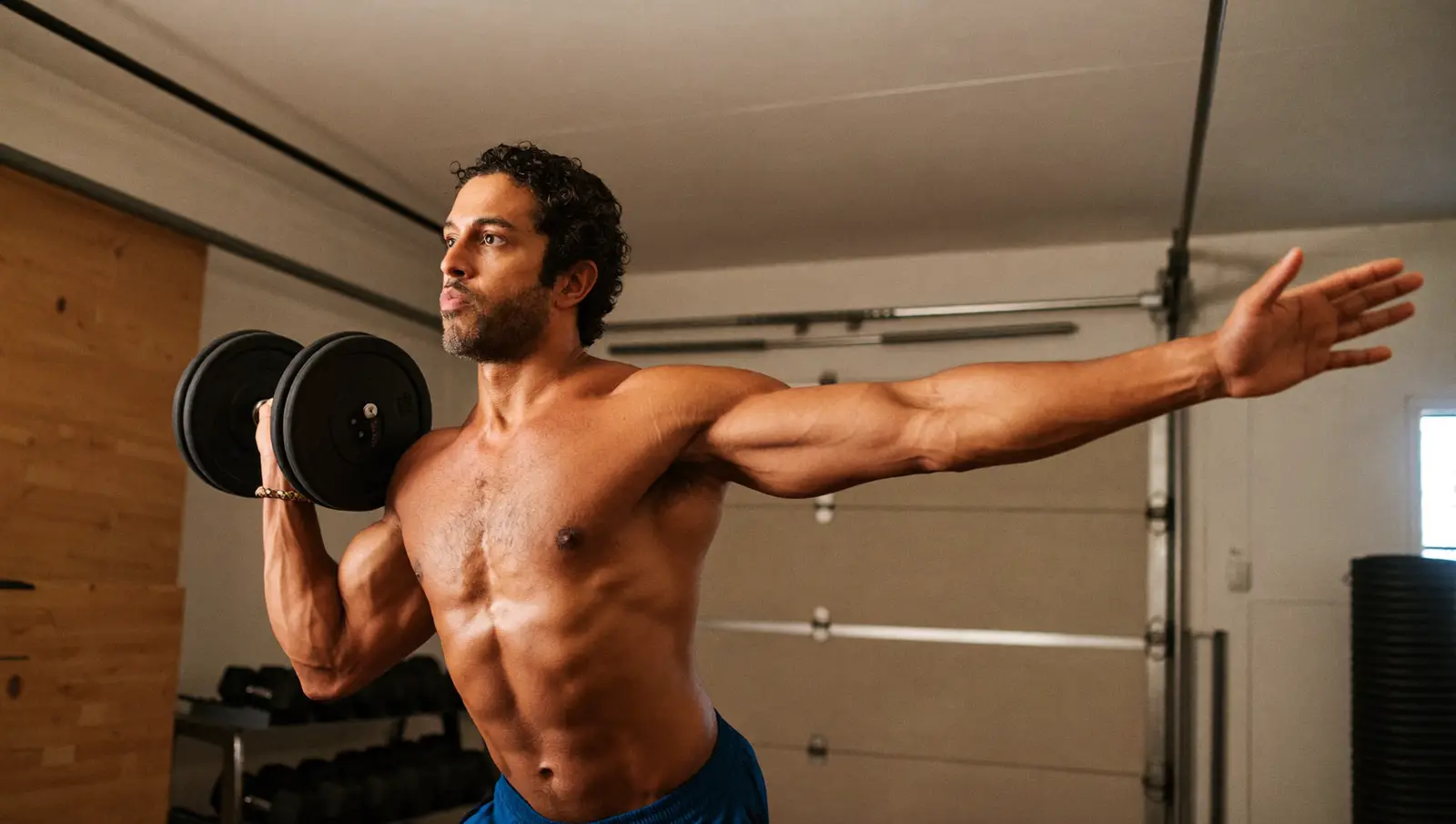
| Lateral raise | Slight bend in the elbows, slight lean forward | Lift to shoulder height, lead with the elbows |
| Incline rear-delt raise | Chest on a 30° incline bench | Arms wide, thumbs slightly down, lift to shoulder height |
| Curl | Elbows at your sides | Elbows stay put; lower for two seconds |
| Overhead extension | Both hands under the top plate | Elbows point forward, not out |
Workouts by level
Same structure, different volume. Pick the row that matches how long you've been lifting.
| Level | Moves | Sets on big moves | Sets on small moves | Time |
|---|---|---|---|---|
| Beginner (0–6 months) | Moves 1–6 of the home version | 2 × 10–12 | 2 × 12–15 | 35 min |
| Intermediate (6 months–2 years) | Full home or gym version | 3 × 8–12 | 2–3 × 10–15 | 40–50 min |
| Advanced (2+ years) | Gym version plus 2 sets of push-ups or a dumbbell pullover | 3–4 × 6–10 | 3 × 12–15 | 50–60 min |
Beginners progress fastest by adding weight almost every week. Advanced lifters add sets first, then weight. The how many sets per muscle group guide shows how much is enough.
A 30-minute version
Short on time? Do four pairs, 2 sets each, with 45 seconds between moves.
| Pair | Exercise | Sets × reps |
|---|---|---|
| A1 | Flat dumbbell press | 2 × 8–10 |
| A2 | One-arm dumbbell row | 2 × 10 each side |
| B1 | Seated overhead press | 2 × 8–12 |
| B2 | Bent-over two-dumbbell row | 2 × 10–12 |
| C1 | Lateral raise | 2 × 12–15 |
| C2 | Curl to overhead extension, alternating sets | 2 × 10–12 each |
That's 14 sets. Do it twice a week and every upper body muscle still gets trained. For more on time, see how long should a workout be.
Where it fits in your week
Two upper days, with legs or rest between them. Two common weeks:
| Day | 4-day upper / lower | 3-day week |
|---|---|---|
| Monday | Upper (home or gym version) | Upper |
| Tuesday | Lower | Rest or cardio |
| Wednesday | Rest | Lower |
| Thursday | Upper (30-minute version) | Rest |
| Friday | Lower | Upper |
| Weekend | Rest, walk or yoga | Rest, walk or yoga |
The 4-day week is the classic 4 day workout split. For a 3-day full-body option, see the 3 day workout split, and for every layout, the workout split hub.
What dumbbells you need at home
One adjustable pair covers the whole plan. Fixed dumbbells work too, but you need several pairs.
| Setup | What to get | Good for |
|---|---|---|
| Starter | Adjustable pair from 5 to 50 lb (2–23 kg) | Beginners, most women and many men for the first year |
| Long term | Adjustable pair up to 70–90 lb (32–41 kg) | Heavy rows and presses after a year or two |
| Fixed pairs | 3 pairs, for example 10, 20 and 35 lb (5, 9 and 16 kg) | Raises, curls and presses, if you don't mind fewer jumps |
| Bench | Flat or adjustable, at least to 30° and upright | Incline press, seated press, chest-supported row |
- No bench? Use the floor press and a sturdy chair for rows.
- Small jumps matter. Pick a set that goes up by 2.5 or 5 lb (1 or 2 kg), so raises and curls can progress.
The warm-up: 5 minutes
- 10 arm circles forward and back.
- 10 shoulder rolls and 10 wall angels.
- 10 push-ups, on your knees or against a bench if needed.
- One light set of the first press: about half your working weight for 12 reps.
How to progress over 8 weeks
Add reps first, then weight. Here's a simple 8-week ladder:
| Weeks | What to do | Reps left |
|---|---|---|
| 1–2 | Find your weights, 2 sets on big moves | 3 |
| 3–5 | 3 sets; add 2.5 to 5 lb (1–2 kg) when every set hits the top | 1–3 |
| 6 | Add a 4th set to the first press and row | 1–2 |
| 7 | Same weights, aim for 1 more rep per set | 1–2 |
| 8 | Lighter week: same moves, half the sets | 4 |
After week 8, swap two moves (for example flat press to dumbbell squeeze press) and start again. If your numbers stall for two weeks, take a deload week.
Common mistakes and fixes
| Mistake | Fix |
|---|---|
| Presses only, no rows | Match every push with a pull |
| Same weight for every move | Pick a weight per move |
| Swinging the lateral raise | Lighter dumbbells, slow 2-second lowering |
| Rowing with your lower back | Brace, keep your torso still, or use the chest-supported row |
| Short reps on the press | Lower until the dumbbells reach chest level |
| Arms first, presses last | Big moves first, arms last |
| Upper body two days in a row | Put legs, cardio or rest between |
How Nuvela builds your upper body day
Tell Nuvela your goal, your experience, where you train and how many days and minutes you have, and it builds your week, including your upper and lower days.
Snap a photo of your dumbbells and bench, and the plan sticks to that gear. It sets the weight for every set and adjusts it as you log.
- Swap any move, and there's a video for every move in your plan.
- Train Together: a friend trains on the same days with their own workout, and you share one streak.
- Strength, cardio and yoga sit in one weekly plan, so your lower body and rest days are planned too.
To try it with your own answers, build your week.
More questions about upper body dumbbell workouts
Can I build my chest with only dumbbells?
Yes. Flat and incline presses cover it, and the ACSM position stand found equipment type did not consistently change results. For a chest-only plan, see chest workouts with dumbbells.
What about back and arms?
Two rows per session cover the back. Want more? Use back workouts with dumbbells or arm workouts with dumbbells. For a whole-body dumbbell week, see the dumbbell workout plan.
Should I do a full upper body day or split chest and back?
A full upper body day, if you train 2 to 4 days a week. Each muscle gets trained twice a week that way. Separate chest and back days fit 5- or 6-day weeks, like push pull legs.
Common questions
Is a dumbbell upper body workout enough to build muscle?
Yes. In the 2026 ACSM position stand, the type of equipment did not consistently change results. Weekly sets, sessions per week and effort mattered more.
Twice a week with this workout puts your back above 10 hard sets a week; add push-ups at the end to bring chest there too.
How many times a week should I train upper body?
Twice a week for most people, with at least one day between sessions. The ACSM position stand ties strength gains to two or more sessions a week.
Can I do upper body two days in a row?
It's better not to. Put a lower body day, cardio or a rest day between upper body sessions, so your chest, back and shoulders are ready for full effort.
How long should an upper body dumbbell workout be?
About 40 minutes with paired sets, or 50 with straight sets, plus a 5-minute warm-up. Short on time? Do the 30-minute version above.
What weight dumbbells should I use for upper body?
Different weights for different moves. Rows and presses take the heaviest pair, lateral raises the lightest. Pick each so the last set ends with 1 to 3 reps left in the target range.
Sources
- ACSM Position Stand, Resistance Training Prescription for Muscle Function, Hypertrophy, and Physical Performance in Healthy Adults, Medicine and Science in Sports and Exercise (2026). More muscle growth with 10 or more sets per week; strength gains with 2 or more sessions a week; equipment type did not consistently change outcomes.
- A comparison of muscle activity and 1-RM strength of three chest-press exercises with different stability requirements, Journal of Sports Sciences (2011). Dumbbell press max was 17% lower than barbell; chest and front shoulder activity did not differ.
- Give it a rest: a systematic review with Bayesian meta-analysis on the effect of inter-set rest interval duration on muscle hypertrophy, Frontiers in Sports and Active Living (2024). 9 studies: a small benefit to resting more than 60 seconds between sets, and no clear difference once rest went past 90 seconds.
- Triceps brachii hypertrophy is substantially greater after elbow extension training performed in the overhead versus neutral arm position, European Journal of Sport Science (2023). 12 weeks: overhead extensions grew the whole triceps 19.9% vs 13.9% with arms at the side.
Related guides
- Arm Workouts With Dumbbells: Biceps + Triceps Plan
- Dumbbell Shoulder Workout: 5 Moves, Sets and Reps
- Dumbbell Workout Plan: 3 Days a Week, Home or Gym
Exercises in this guide
- Push-up
- One-arm dumbbell row
- Dumbbell curl
- Dumbbell bench press
- Seated dumbbell shoulder press
- Dumbbell overhead extension
- Dumbbell lateral raise
- Incline dumbbell press
- Incline dumbbell curl
- Chest supported row
- Overhead cable extension
- Arnold press
- Hammer curl
- Dumbbell floor press
- Dumbbell skull crusher
- Dumbbell pullover
- Arm circles
- Shoulder rolls
- Wall angels
- Dumbbell squeeze press
Try 7 days, no card needed
