

A deload week is a planned easy week: same days, same exercises, about half the sets and lighter weights. Most people who train hard take one every 4 to 8 weeks. You come back fresher without losing the habit or your progress.
Let your plan handle the easy weeks too. Answer a few questions and build your week: Nuvela sets every weight, keeps tracking through a lighter week and picks up from what you actually lifted. Get Nuvela on Google Play.
Same
Days and exercises
Your usual days, your usual moves.
About half
Sets
1–2 per exercise instead of 3–4.
Lighter
Weight
About 10–20% lighter, 4–5 reps left.
Shorter
Sessions
25–35 min instead of 45–60.
When
Every 4 to 8 weeks
Or when the signs pile up.
The plan
A deload is not a week off. You keep the habit and drop how hard the week is. A 2023 expert consensus defined it as "a period of reduced training stress designed to mitigate physiological and psychological fatigue, promote recovery, and enhance preparedness for subsequent training."
Here are the rules for a deload week:
| Variable | Normal week | Deload week |
|---|---|---|
| Training days | Your usual, for example 4 | Same days |
| Exercises | Your usual | Same exercises |
| Sets per exercise | 3–4 | 1–2, about half |
| Reps per set | 8–12 | Same, or 2 fewer |
| Weight | Your working weight | About 10–20% lighter |
| Effort | 2–3 reps left in the tank | 4–5 reps left |
| Session length | 45–60 min | 25–35 min |
Sample deload week for a 4-day upper/lower split
| Day | Exercise | Normal week | Deload week |
|---|---|---|---|
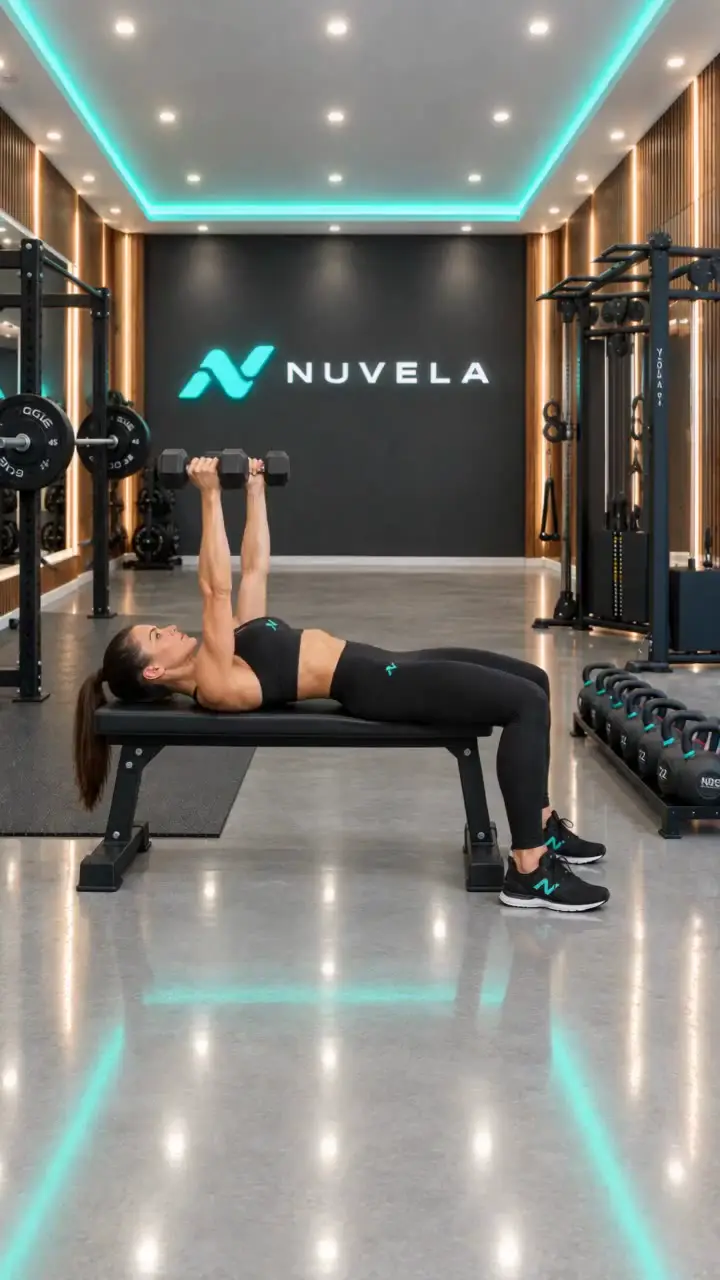
| Mon, upper | Dumbbell bench press | 4 × 8–10 | 2 × 8 |
| Mon, upper | One-arm dumbbell row | 4 × 10 per arm | 2 × 10 per arm |
| Mon, upper | Dumbbell shoulder press | 3 × 10 | 1 × 10 |
| Tue, lower | Back squat | 4 × 6–8 | 2 × 6 |
| Tue, lower | Romanian deadlift | 3 × 8–10 | 2 × 8 |
| Tue, lower | Seated leg curl | 3 × 12 | 1 × 12 |
| Thu, upper | Lat pulldown | 4 × 10 | 2 × 10 |
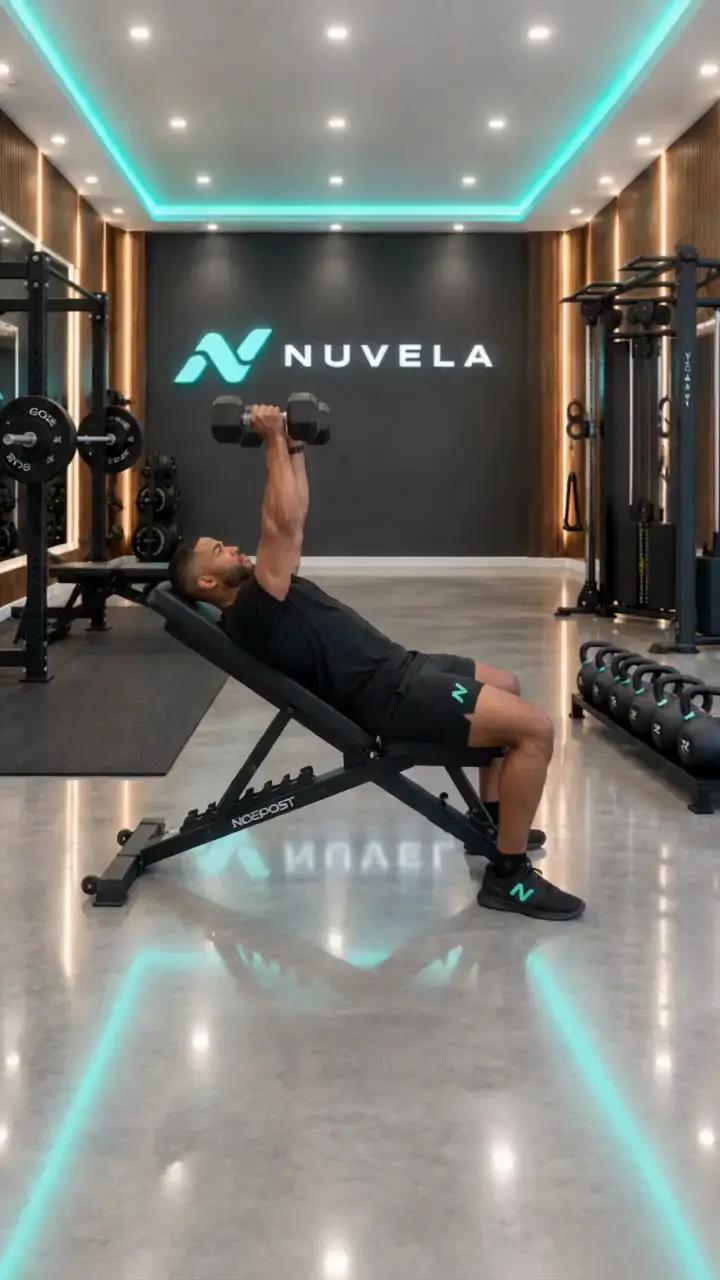
| Thu, upper | Incline dumbbell press | 3 × 10 | 2 × 10 |
| Thu, upper | Cable face pull | 3 × 15 | 1 × 15 |
| Fri, lower | Leg press | 4 × 10–12 | 2 × 10 |
| Fri, lower | Walking lunge | 3 × 10 per leg | 1 × 10 per leg |
| Fri, lower | Standing calf raise | 3 × 12–15 | 2 × 12 |




It uses the same days as our upper lower split. On a 3-day or 5-day plan, apply the same cuts to every session.
That's 41 working sets in a normal week and 20 in the deload week. Total weekly sets drop by a little more than half, and each session gets about 20 minutes shorter.
Get this week built for your gym.
Plan your workout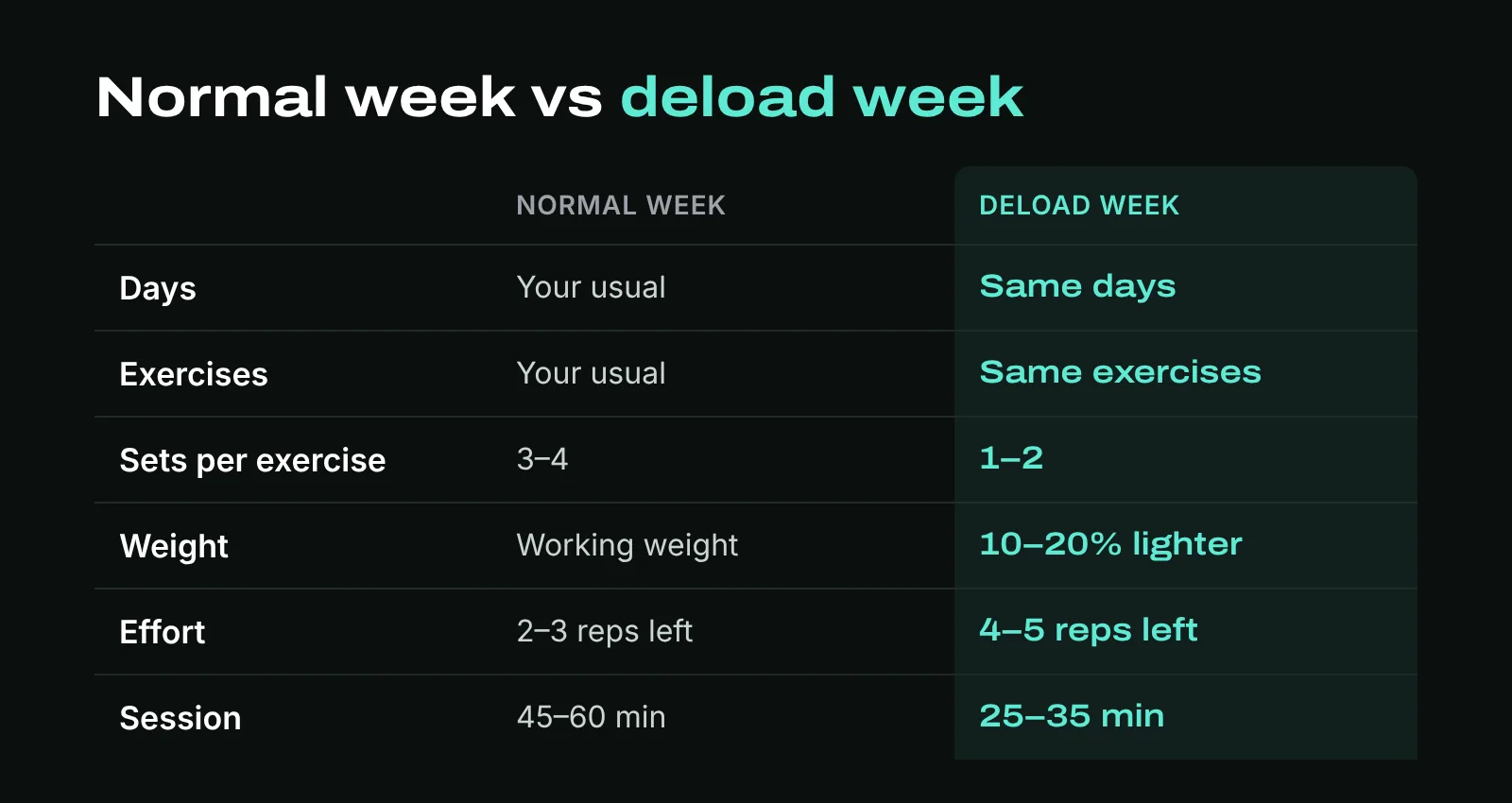
How to pick the weight during a deload
- Start from your last normal week. Take your working weight and drop it 10 to 20%. A 200 lb (91 kg) squat for 4 × 6 becomes 160 to 180 lb (73 to 82 kg) for 2 × 6. Not sure what your heavy weight is? The one rep max calculator estimates it from a recent hard set.
- Check the effort. Each set should feel like you could do 4 or 5 more reps.
- No tests. Don't try a max or chase a rep record this week.
- Come back at your last normal weights. In the first week after the deload, use the weights from before it, not heavier. Then add 5 lb (2 kg) when every set hits the top of the rep range.
| Normal working weight | 10% lighter | 20% lighter |
|---|---|---|
| 50 lb (23 kg) dumbbells | 45 lb (20 kg) | 40 lb (18 kg) |
| 135 lb (61 kg) | 120 lb (54 kg) | 110 lb (50 kg) |
| 185 lb (84 kg) | 165 lb (75 kg) | 150 lb (68 kg) |
| 225 lb (102 kg) | 205 lb (93 kg) | 180 lb (82 kg) |
Round to the nearest weight your gym has. When in doubt, go lighter: a deload set that feels too easy is doing its job.
Swaps for a deload week
| If you normally do | Deload swap | Sets × reps |
|---|---|---|
| Barbell back squat | Goblet squat | 2 × 10 |
| Barbell bench press | Dumbbell bench press | 2 × 10 |
| Conventional deadlift | Romanian deadlift, lighter | 2 × 8 |
| Weighted pull-up | Lat pulldown | 2 × 10 |
| Hard intervals | Easy stationary bike or brisk walk | 20–30 min |
| One lifting day | A 30-minute yoga session | 1 session |
Swaps are optional. If your usual moves feel fine at the lighter weight, keep them: practicing the same lifts keeps the pattern sharp for the next block.

When to take a deload week
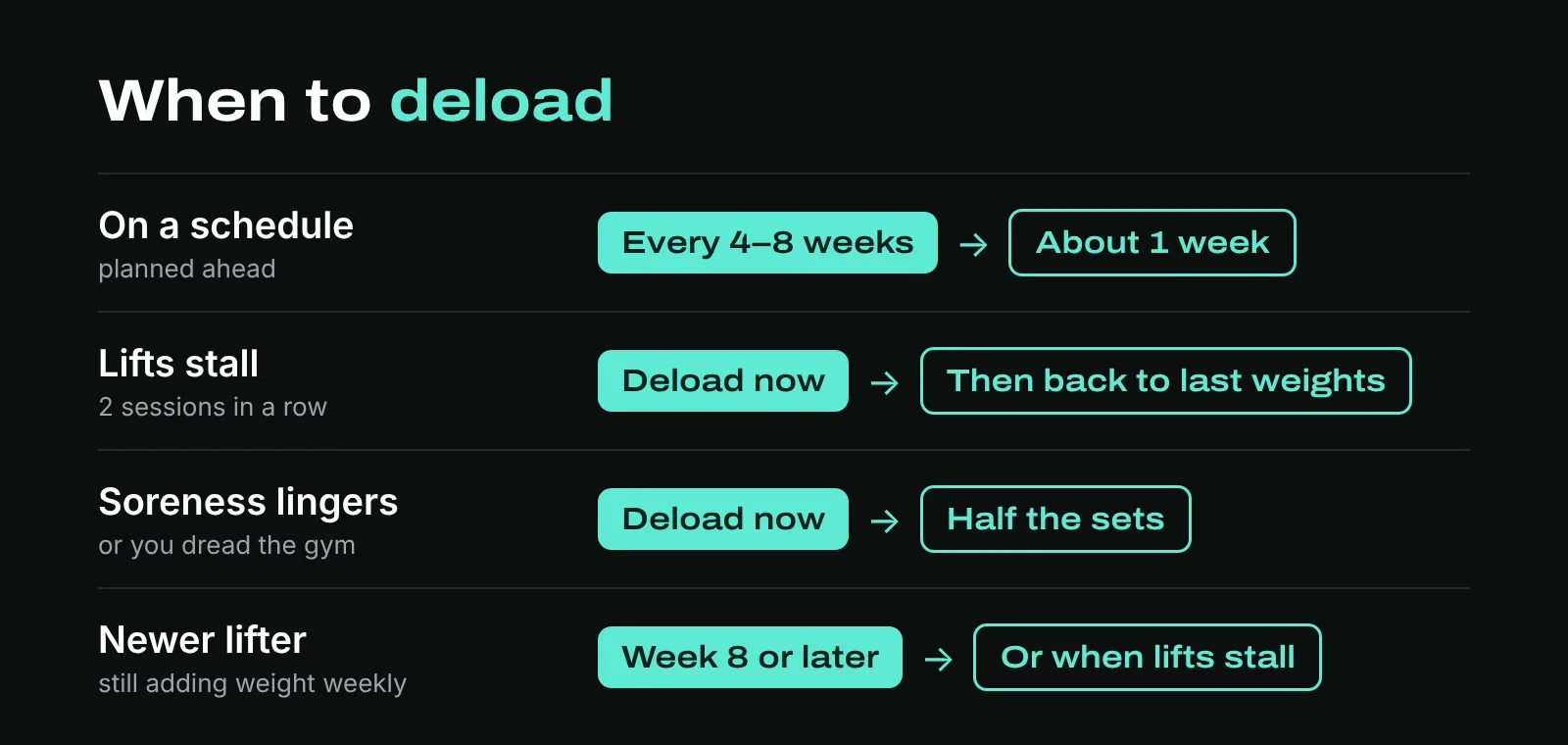
- On a schedule. Every 4 to 8 weeks. The 2023 consensus paper describes deloads as generally every 4 to 6 weeks for about 7 days. Athletes in the 2024 survey averaged one every 5.6 weeks, lasting 6.4 days.
- When the signs pile up. Your main lifts stall or go down for 2 sessions in a row, you dread the gym, or soreness hangs around longer than usual. Survey athletes also deloaded when performance stalled.
- If you're newer. Under 6 months of lifting and still adding weight most weeks? You can push your first deload to week 8 or later.
Use this checklist at the end of each week. Two or more yes answers is a good reason to deload next week.
- A main lift stalled or dropped for 2 sessions in a row.
- Warm-up weights feel heavy.
- Soreness lasts into your next session for the same muscle.
- You've trained hard for 6 or more weeks without an easy week.
- You're skipping sessions you'd normally enjoy.
- A busy week (travel, work, short nights) is coming anyway.
The last one is a useful trick. Line up your deload with a week you'd train less anyway, like a work trip or a holiday.
Four ways to deload
The 2023 consensus listed four levers: reps, sets, load and effort. Most people pull two at once.
| Method | What you change | Best for |
|---|---|---|
| Cut sets (default) | Half the sets, same reps, 10–20% lighter | Most lifters, any split |
| Cut weight only | Same sets, 30–40% lighter, easy reps | Lifters who like full sessions |
| Cut effort only | Same sets and weight, stop 4–5 reps short | Newer lifters still learning form |
| Cut days | One fewer session, the rest half sets | Busy weeks, travel |
Good
- Cutting sets keeps your weights familiar and sessions short
- Cutting effort is the simplest change to remember
Keep in mind
- Cutting weight only keeps sessions long
- Cutting days means some muscles get one session that week
Deload week for every split
Same rule everywhere: same days, about half the sets, lighter weights. Here's what that looks like by split.
| Split | Normal session | Deload session |
|---|---|---|
| Full body, 3 days | 5–6 moves × 3 sets | 5–6 moves × 1–2 sets |
| 3 day workout split | 6 moves × 3–4 sets | 6 moves × 2 sets |
| 4 day workout split | 5–6 moves × 3–4 sets | 5–6 moves × 1–2 sets |
| Push pull legs, 6 days | 5–6 moves × 3–4 sets | First 3 days only, 2 sets each, or all 6 days at 1–2 sets |
| Bro split | 5–7 moves × 3–4 sets | 4–5 moves × 2 sets |
On a 6-day plan, running only the first three days is a clean way to halve the week. Not sure which split you're on? Our workout split guide lays out each one.
Your weekly sets per muscle should land at roughly half of normal. If you usually do 12 to 16 sets for a muscle, aim for 6 to 8 during the deload. Our guide on how many sets per muscle group has the normal ranges.
Sample deload week for 3 full-body days
Here's the same idea on a 3-day full-body plan with dumbbells and a bench, at home or in the gym. Each session takes about 25 minutes.
| Day | Exercise | Normal week | Deload week |
|---|---|---|---|
| Mon, Wed, Fri | Goblet squat | 3 × 8–10 | 2 × 8 |
| Mon, Wed, Fri | Dumbbell bench press | 3 × 8–12 | 2 × 8 |
| Mon, Wed, Fri | One-arm dumbbell row | 3 × 10 per arm | 2 × 10 per arm |
| Mon, Wed, Fri | Dumbbell Romanian deadlift | 3 × 10 | 1 × 10 |
| Mon, Wed, Fri | Plank | 2 × 30–45 sec | 1 × 30 sec |
If you normally use 40 lb (18 kg) dumbbells on the bench press, use 35 lb (16 kg) for the deload. For the full home program, see our dumbbell workout plan.
Deload week or a week off?
Should you take the whole week off instead? A 2024 trial tested that in 39 trained men and women. One group stopped lifting for a week at the midpoint of a 9-week program.
Their gains in muscle size, muscular endurance and power matched the group that kept training. Their lower-body strength improved less. If strength is your goal, a light week beats an empty one.
Good
- You keep the habit and drop how hard the week is
- A light week beats an empty one for strength
Keep in mind
- No tests: don't try a max or chase a rep record
- Come back at your last normal weights, not heavier
| Deload week | Week off | |
|---|---|---|
| Muscle size | Kept | Kept, in the 2024 trial |
| Lower-body strength | Keeps building | Smaller gains, in the 2024 trial |
| Habit | Same days, same routine | Broken for a week |
| When it makes sense | Most planned easy weeks | Holidays, travel with no gym |
Cardio and yoga in a deload week
Keep cardio easy and keep yoga as it is. A deload is about lowering how hard the week is, not about stopping movement.
| Normal week | Deload week |
|---|---|
| Hard intervals or the Norwegian 4x4 workout | Easy bike, row or walk, 20–30 min |
| Easy cardio, 30–60 min | Same, or a little shorter |
| Yoga session, 15–60 min | Same; a good swap for one lifting day |
| Cardio after lifting | 10 minutes easy, or skip it |
A 30-minute yoga for strength session fits well on the deload week's off days. For where cardio goes in a normal week, see cardio before or after weights.
Where deloads fit in a training block
Pick a block length that matches how hard you train. The deload is the last week of each block.
| Block | Hard weeks | Deload | Good for |
|---|---|---|---|
| 5 weeks | 4 | Week 5 | High-volume or 5–6 day plans |
| 6 weeks | 5 | Week 6 | Most intermediate lifters |
| 8 weeks | 7 | Week 8 | Newer lifters, 3-day plans |
Inside each block, add weight or reps as usual. The deload resets fatigue so the next block starts from a stronger base.
The week after the deload
Go back to your last normal weights, not heavier. Most lifters feel strong after a deload; let that show up as easier sets, then add weight the normal way.
| Day | Sets | Weight | Effort |
|---|---|---|---|
| First session back | Your normal sets | Your last normal weights | 2–3 reps left |
| Rest of that week | Normal sets | Same, or +5 lb (2 kg) if every set hit the top of the range | 2–3 reps left |
| Week 2 onward | Normal | Add weight at the top of each range | 1–3 reps left |
Common deload mistakes and fixes
| Mistake | Fix |
|---|---|
| Testing a max because you feel fresh | Save it for week 2 or 3 of the next block |
| Cutting sets but keeping heavy weights and hard sets | Also drop the weight 10–20% and stop 4–5 reps short |
| Skipping the gym entirely | Keep your usual days, just shorter sessions |
| Deloading every 2–3 weeks | Train hard for at least 4 weeks between deloads |
| Never deloading | Put one on the calendar every 5–8 weeks |
| Coming back heavier than before | Start at your last normal weights |
A deload week also takes far less time. Sessions of 25 to 35 minutes fit almost any schedule; see how long should a workout be for the normal-week numbers.
Using Nuvela in a deload week
Nuvela builds your week from a few questions: your goal, experience, where you train, and your days and minutes. It sets every weight and adjusts it as you log, so keep logging through a lighter week and your numbers stay tied to what you actually lifted.
- Swap any heavy move, and watch a video for every move if you're trying a lighter version for the first time.
- Strength, cardio and yoga share one weekly plan, and a yoga session can run from 15 to 60 minutes.
- Train Together: you and a partner keep one shared streak, so a light week still counts.
See a week built from your own answers in the workout planner.
More questions about deload weeks
How long should a deload last?
About a week. The 2023 consensus describes deloads of about 7 days, and athletes in the 2024 survey averaged 6.4 days. Longer than that and it's no longer a deload, it's a break.
Can I build muscle during a deload week?
That's not its job. A deload keeps what you've built and sets up the next block. Even a full week off in the 2024 trial left gains in muscle size equal to the group that kept training.
Common questions
What is a deload week?
A planned week of lighter training. You train on your usual days with fewer sets, lighter weights and easier sets, so you start the next block fresh.
How often should you deload?
Every 4 to 8 weeks for most people who train hard. Athletes in a 2024 survey averaged one about every 5 to 6 weeks. Newer lifters who still progress every week can go longer.
Should I take a full week off instead?
You can, but a light week is the better bet for strength. In a 2024 trial, a week off midway through 9 weeks led to smaller lower-body strength gains, while gains in muscle size were the same.
Will I lose muscle during a deload week?
No. You're still training. Even a full week off in the 2024 trial left gains in muscle size equal to the group that kept lifting.
Do beginners need a deload week?
Not as often. If you're still adding weight most sessions, take one every 8 to 12 weeks, or when your lifts stall.
Sources
- Integrating Deloading into Strength and Physique Sports Training Programmes: An International Delphi Consensus Approach, Sports Medicine – Open (2023). Consensus definition of deloading as a period of reduced training stress; generally every 4 to 6 weeks for about 7 days, by cutting reps, sets, load or effort.
- Deloading Practices in Strength and Physique Sports: A Cross-sectional Survey, Sports Medicine – Open (2024). 246 athletes: deloads lasted 6.4 ± 1.7 days every 5.6 ± 2.3 weeks; volume, load and effort went down, training frequency and exercises stayed the same.
- Gaining more from doing less? The effects of a one-week deload period during supervised resistance training on muscular adaptations, PeerJ (2024). 39 trained men and women: a full week off midway through 9 weeks gave the same gains in muscle size, endurance and power, but smaller lower-body strength gains.
Related guides
- 4 Day Workout Split: 3 Layouts and a Full Plan
- How Many Sets per Muscle Group? 10–20 a Week
- Upper Lower Split: 4-Day Plan With Sets and Reps
Exercises in this guide
- Dumbbell bench press
- One-arm dumbbell row
- Seated dumbbell shoulder press
- Back squat
- Seated leg curl
- Lat pulldown
- Incline dumbbell press
- Face pull
- Leg press
- Standing calf raise machine
- Goblet squat
- Barbell bench press
- Conventional deadlift
- Dumbbell Romanian deadlift
- Pull-up
- Stationary bike
- Brisk walking
- Plank
Try 7 days, no card needed
