
The plan
The short version: do first whatever matters most to you. The first thing in a session gets your freshest legs and your best focus.
| Your main goal | Do this first | Then | Why |
|---|---|---|---|
| Get stronger | Weights | Cardio, or a separate day | Lifting first led to about 4 kg more lower-body strength gain in a 2018 meta-analysis |
| Build muscle | Weights | Easy cardio, or a separate day | Hard cardio first leaves less in the tank for your working sets |
| Run or ride a race | Cardio | Weights | Your key runs or rides get your best effort |
| General fitness | Either | The other | Aerobic fitness improved the same in either order |
| Short on time | Weights | 10 to 20 minutes of cardio | Covers both in one visit |
Three rules that make it work:
- Warm up with 5 minutes of easy cardio either way. A bike, rower or brisk incline walk raises your temperature without tiring you out. That's a warm-up, not "cardio first".
- Keep hard intervals and heavy leg days apart. Sprints before squats is the combination that costs the most. Put hard intervals on an upper-body day, after lifting, or on another day. On a push pull legs split, that means keeping sprints away from leg day.
- Separate days beat the same session. In a 2022 review of 43 studies, adding cardio did not reduce gains in strength or muscle size. Explosive strength (jumps, sprints) took a small hit, and more so when both were done in the same session.
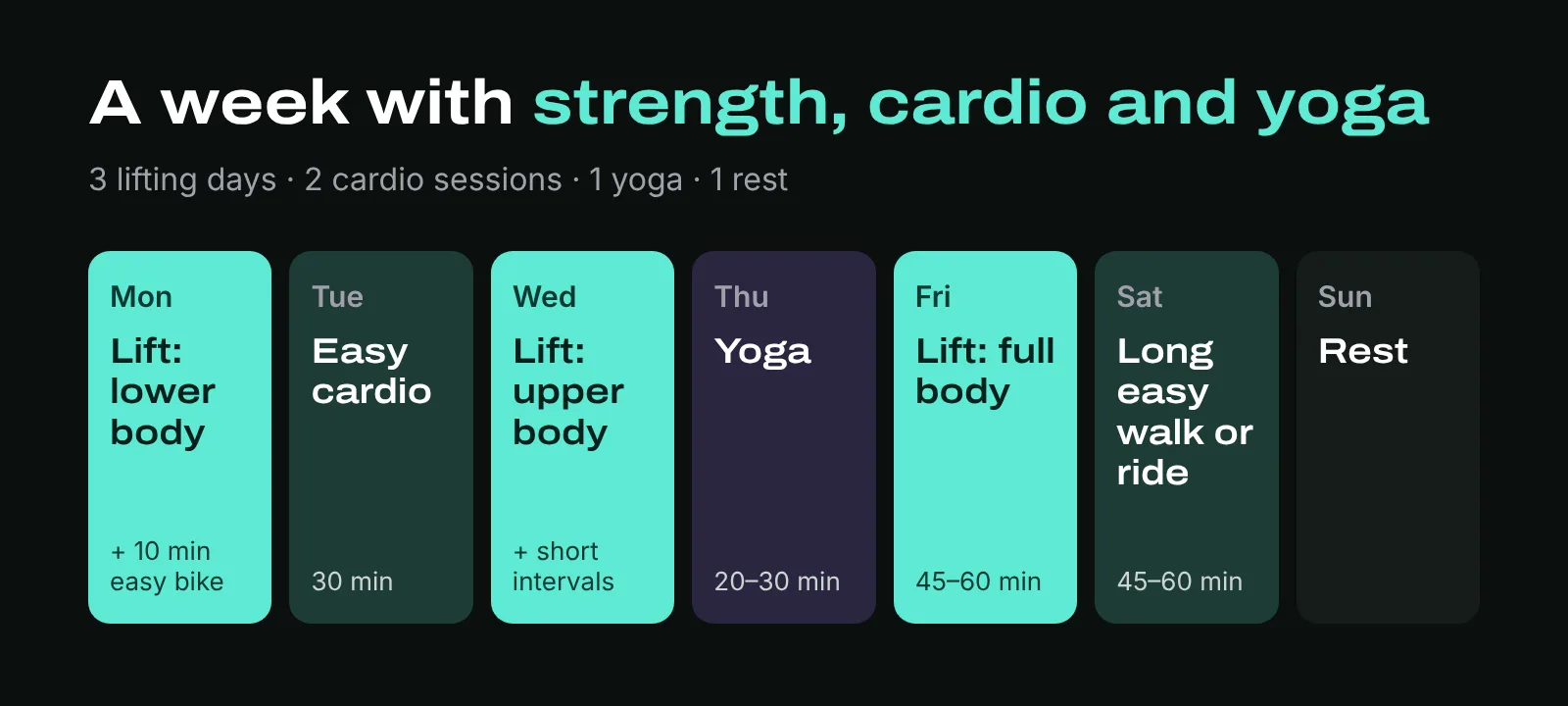
A week with both (3 lifting days, 2 cardio, 1 yoga)
| Day | Session | Length |
|---|---|---|
| Monday | Lift: lower body, then 10 minutes easy bike | 50–60 min |
| Tuesday | Cardio: easy run, bike or rower | 30 min |
| Wednesday | Lift: upper body, then 10 × 30-second intervals | 50 min |
| Thursday | Yoga | 20–30 min |
| Friday | Lift: full body | 45–60 min |
| Saturday | Cardio: long easy walk, hike or ride | 45–60 min |
| Sunday | Rest | – |
Training with a partner? The same week works for two: see our gym workout plan for couples. For the Thursday session, try our 30-minute yoga for strength routine.
That's about 150 minutes of cardio counting the post-lift finishers, in line with the U.S. guideline of 150 to 300 minutes of moderate activity a week, plus three strength days, above the ACSM minimum of two.
Get this week built for your gym.
Plan your workout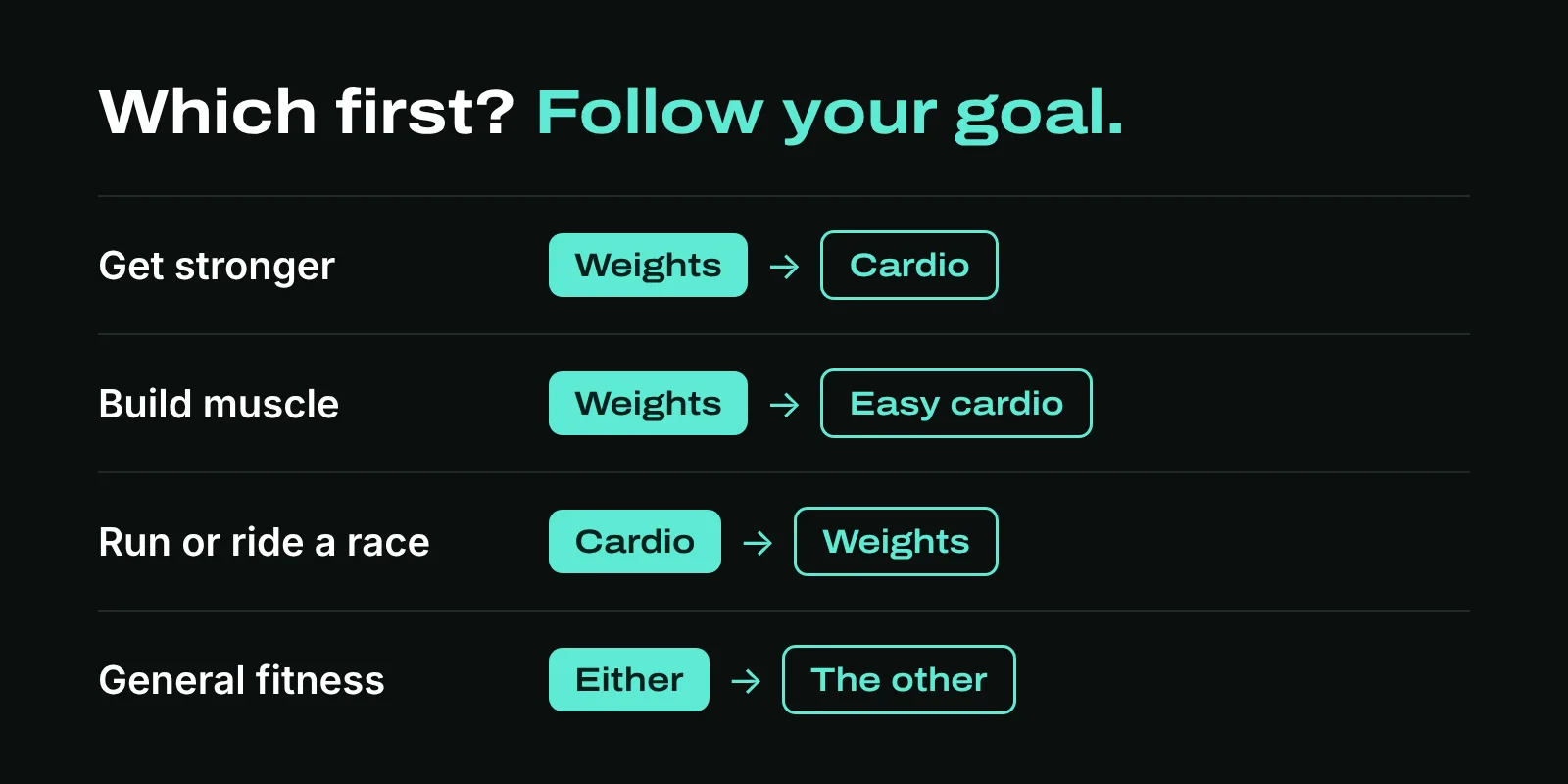
How to pick the weight when cardio comes first
If you do cardio first, for example on a race-training day, expect your legs to be a little weaker. Don't chase your best numbers that day:
- Keep the same rep target, and pick a weight you could lift 2 or 3 more times at the end of the set.
- If your first set feels much harder than usual, drop the weight by about 10% for the rest of the session.
- Save new personal bests for days when you lift first.
On a lift-first day, use your normal weights. When every set hits the top of your rep range, go up by the smallest jump your equipment allows, usually 5 lb.
Swaps when your legs are tired
| If you planned | Swap to | When |
|---|---|---|
| Running intervals | Bike or rower intervals | After a heavy leg day |
| A hard run before lifting | An easy 5-minute warm-up, run later | When strength is the priority |
| Long cardio after lifting | A separate session later in the day | When you have time twice |
| Squats after a long run | Leg press or goblet squat, lighter | On race-training days |
| Cardio and weights on the same day | Cardio on a rest day | When you train 5 or more days |
Strength, cardio and yoga in one plan
Most people end up with a lifting app, a running app and a yoga app, and nothing that decides what goes on which day. In the Nuvela app, strength, cardio and yoga live in one weekly plan. You choose how many sessions of each you want, how long they are and which days you train, and the plan spreads them across your week. For cardio you pick easy, intervals or both. Log what you lift, and the next weights follow. To see a week built from your own answers, try the workout planner.
Short on time? How long should a workout be shows what fits in 30, 45 or 60 minutes, and our social workout app picks compare apps that plan strength, cardio and yoga together.
Common questions
Is it better to do cardio before or after lifting weights?
For strength or muscle, after, or on another day. For endurance goals, before. If you just want to be fit, the order matters little: in the 2018 meta-analysis, aerobic fitness improved the same either way.
Does cardio kill your gains?
Not in the amounts most people do. A 2022 review of 43 studies found that adding cardio did not reduce gains in maximal strength or muscle size. Explosive power took a small hit, mostly when both were done in the same session.
How long should I wait between cardio and weights?
If you split them, a few hours apart is better than back to back, and separate days work best of all. If you only have one visit, lift first and keep the cardio after it short and easy.
Can I do cardio and weights on the same day?
Yes. Lift first, then do 10 to 20 minutes of cardio. Keep hard intervals away from heavy leg days.
Should I do cardio on rest days?
Easy cardio, like walking, cycling or an easy run, fits well on non-lifting days. Keep at least one day a week fully off.
Sources
- The physiological effects of concurrent strength and endurance training sequence: a systematic review and meta-analysis, Journal of Sports Sciences (2018). Strength first: about 4 kg (3.96 kg) more lower-body 1RM gain; VO2max changed the same in either order.
- Compatibility of Concurrent Aerobic and Strength Training for Skeletal Muscle Size and Function: An Updated Systematic Review and Meta-Analysis, Sports Medicine (2022). 43 studies: adding cardio did not reduce gains in maximal strength or muscle size; explosive strength took a small hit, more so when both were done in the same session.
- American College of Sports Medicine, ACSM Unveils Landmark 2026 Resistance Training Guidelines (March 17, 2026). All major muscle groups at least twice a week; consistency over complex programs.
- Physical Activity Guidelines for Americans, 2nd edition, U.S. Department of Health and Human Services. Adults: 150 to 300 minutes of moderate aerobic activity a week, plus muscle-strengthening activity on 2 or more days.
Related guides
- Couples Yoga Poses: 10 Easy Ones for Two
- Gym Workout Plan for Couples: 3 Days, One Bench
- How Long Should a Workout Be? 30, 45 or 60 Min
Try 7 days, no card needed

