
A full cable back workout pulls in three directions: down from above, in from the front and apart at face height. Six moves and 18 hard sets, about 50 minutes, train your lats, mid back and rear shoulders in one session. Below is the full plan, how to pick a weight on any stack, swaps, shorter versions, a grip guide and a sample week.
Let Nuvela set the stack for you. Snap your gym's cable stations, pick your days, and build your week: Nuvela picks the moves and the weight for every set, then adjusts it as you log. Get Nuvela on Google Play.
Pull from above
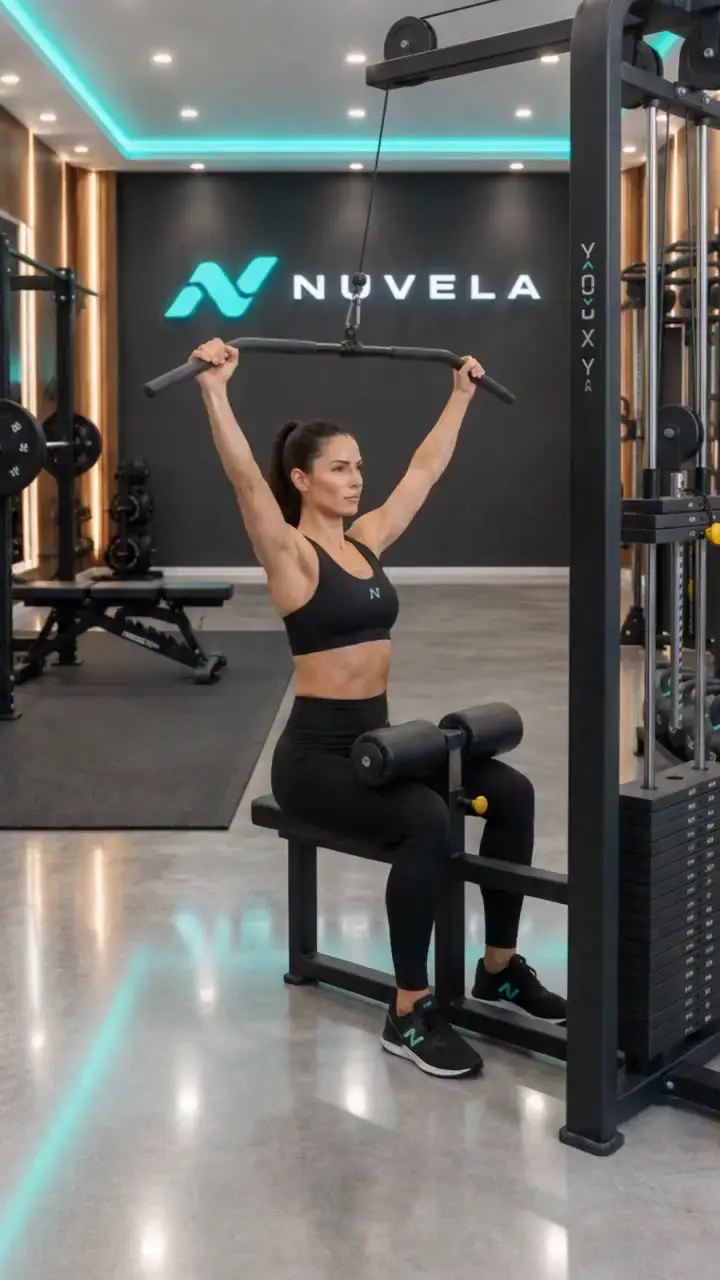
Lat pulldown
Overhand grip, 4 × 8–10.
Pull from the front
Seated and single-arm rows
3 × 8–12 and 3 × 10–12 each.
Lats
Straight-arm pulldown
Bar or rope, 3 × 12–15.
Pull apart
Face pull
Rope at forehead height, 3 × 12–15.
Whole session
6 moves, 18 sets
About 50 minutes.
The plan
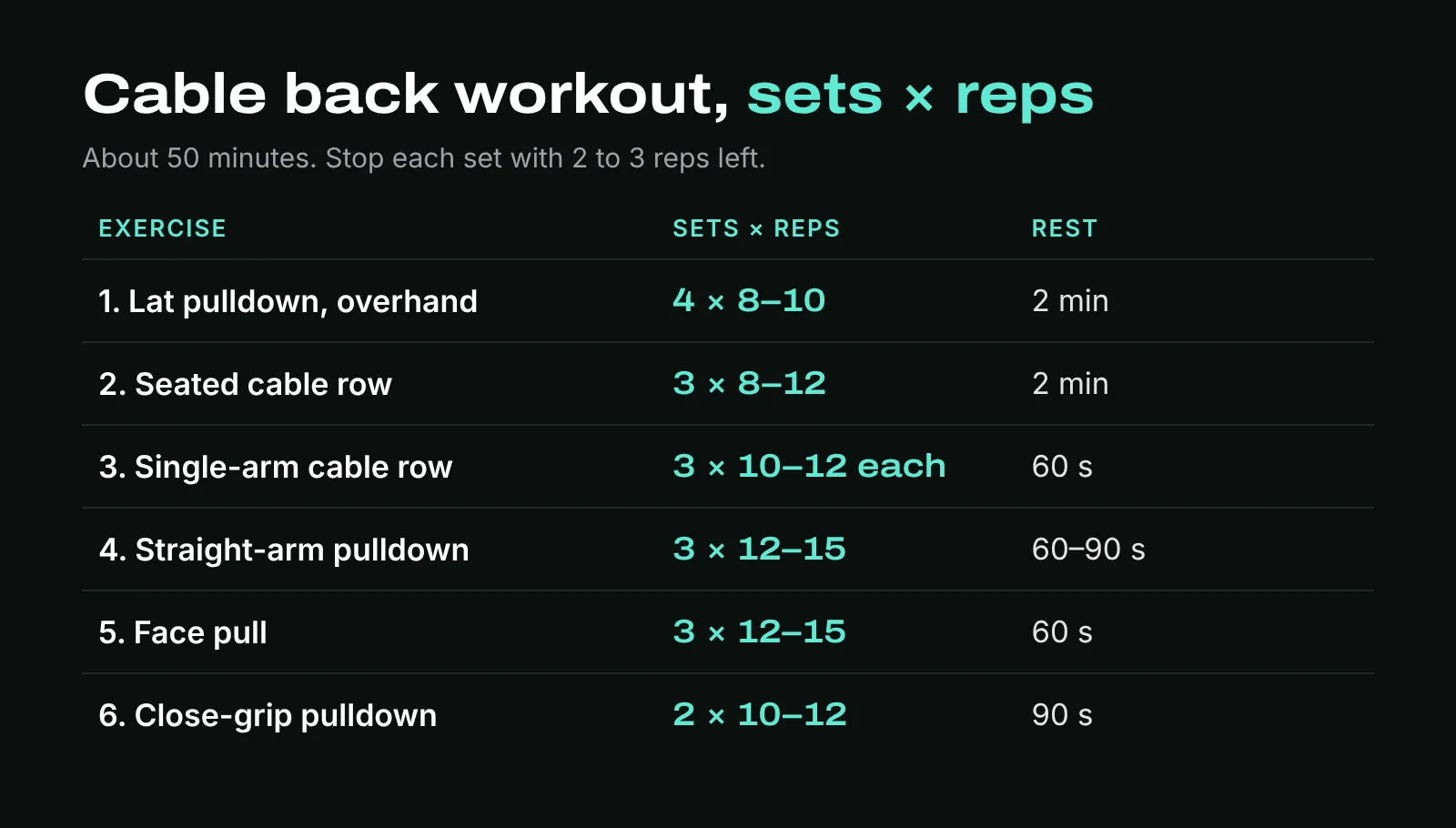
Six moves, 18 working sets, about 50 minutes. You need a lat pulldown, a seated row and one adjustable cable station.
| # | Exercise | Sets × reps | Rest |
|---|---|---|---|
| 1 | Lat pulldown, overhand grip | 4 × 8–10 | 2 min |
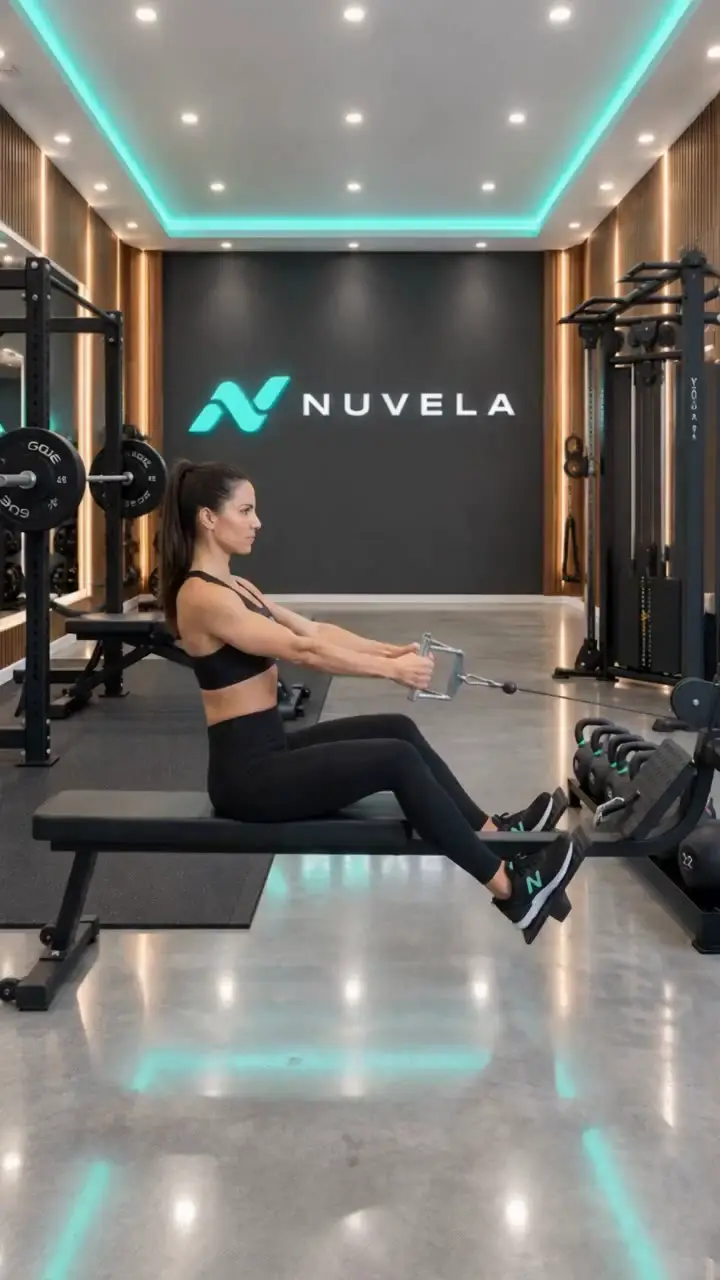
| 2 | Seated cable row, V-handle | 3 × 8–12 | 2 min |
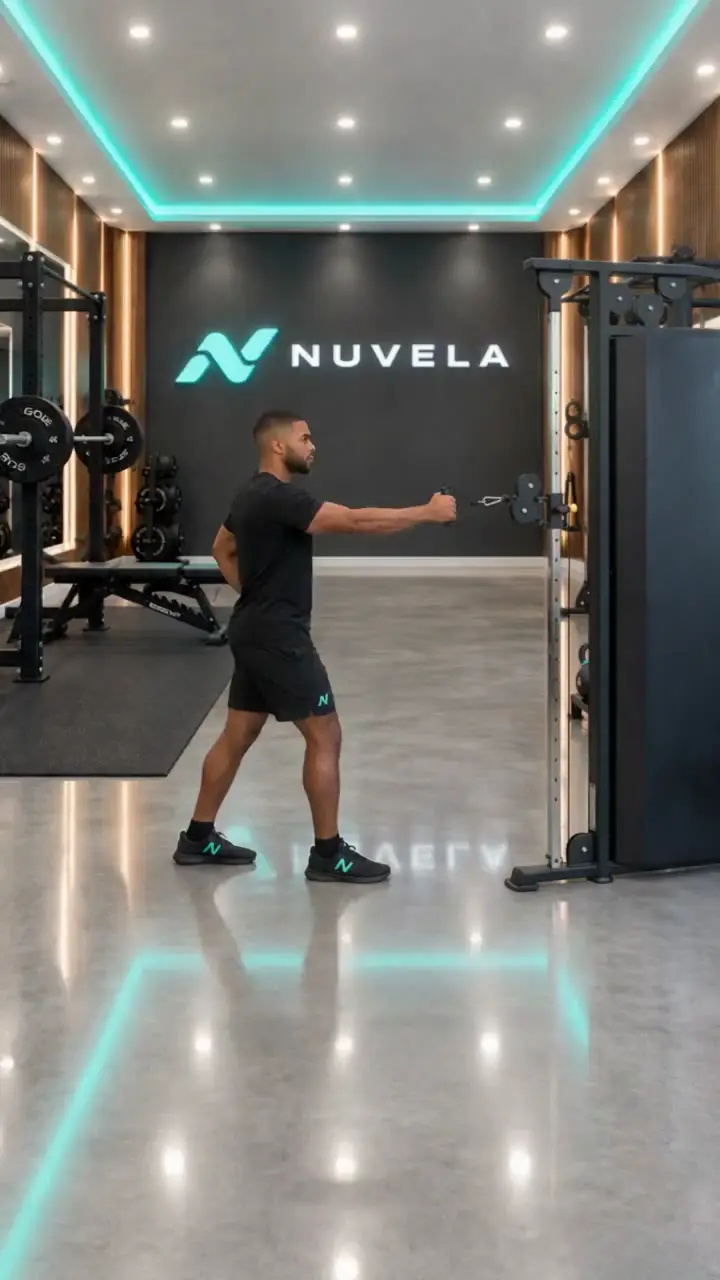
| 3 | Single-arm cable row, half kneeling | 3 × 10–12 each | 60 s |
| 4 | Straight-arm pulldown, bar or rope | 3 × 12–15 | 60–90 s |
| 5 | Face pull, rope at forehead height | 3 × 12–15 | 60 s |
| 6 | Close-grip pulldown, neutral handle | 2 × 10–12 | 90 s |
The rules that make it work:
- Pull in three directions. Pulldowns train your back from above, rows from the front, face pulls from the side. Missing one leaves a gap.
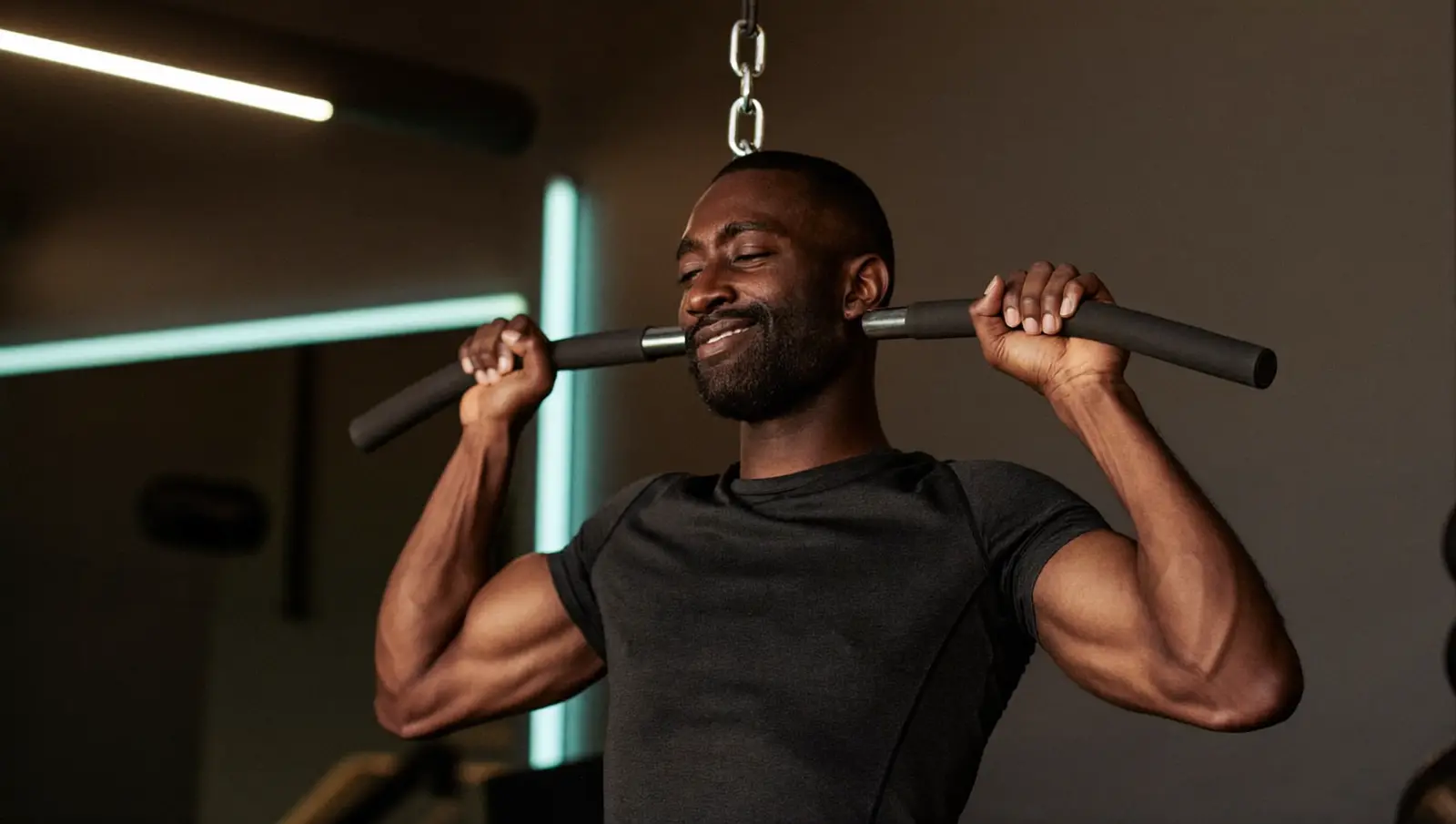
- Overhand on the main pulldown. In a 2010 study, an overhand grip produced more lat activity than an underhand one, and grip width made no real difference. You don't need the widest grip on the bar. Hands just outside your shoulders is enough.
- Full range. Let your arms straighten at the top of each pulldown and reach forward on each row. The 2026 ACSM review linked a full range of motion to more strength.
Form cues for each move
- Lat pulldown: chest up, pull the bar to your upper chest, elbows down toward your back pockets.
- Seated row: sit tall, pull the handle to your belly button, squeeze your shoulder blades together.
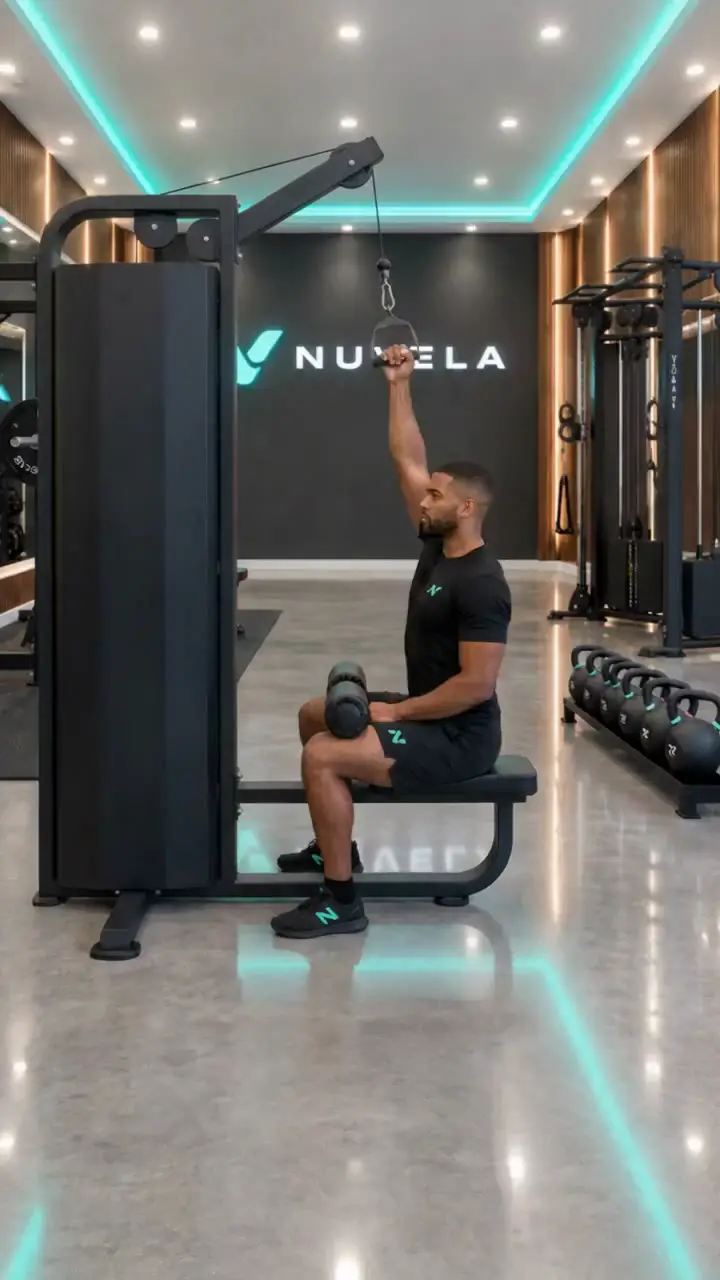
- Single-arm row: pulley at chest height, pull your elbow past your ribs, let the shoulder reach forward on the way back.
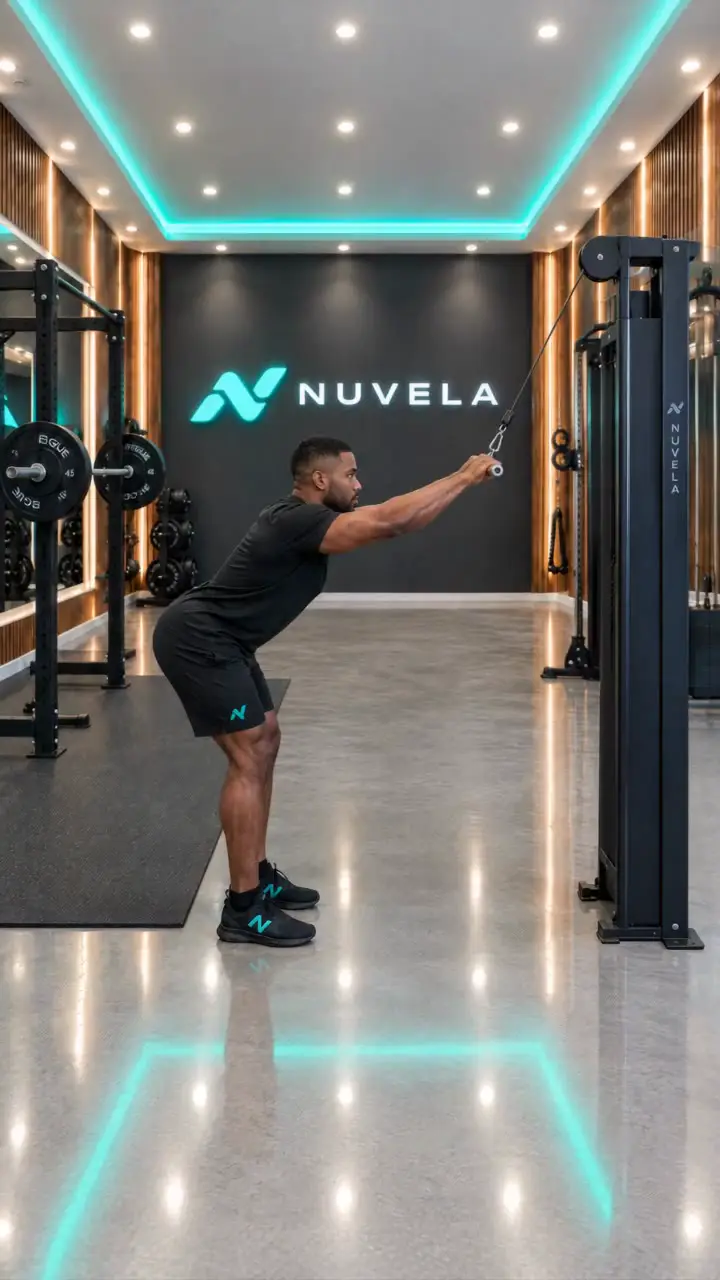
- Straight-arm pulldown: arms nearly straight, sweep the bar from eye level to your thighs.
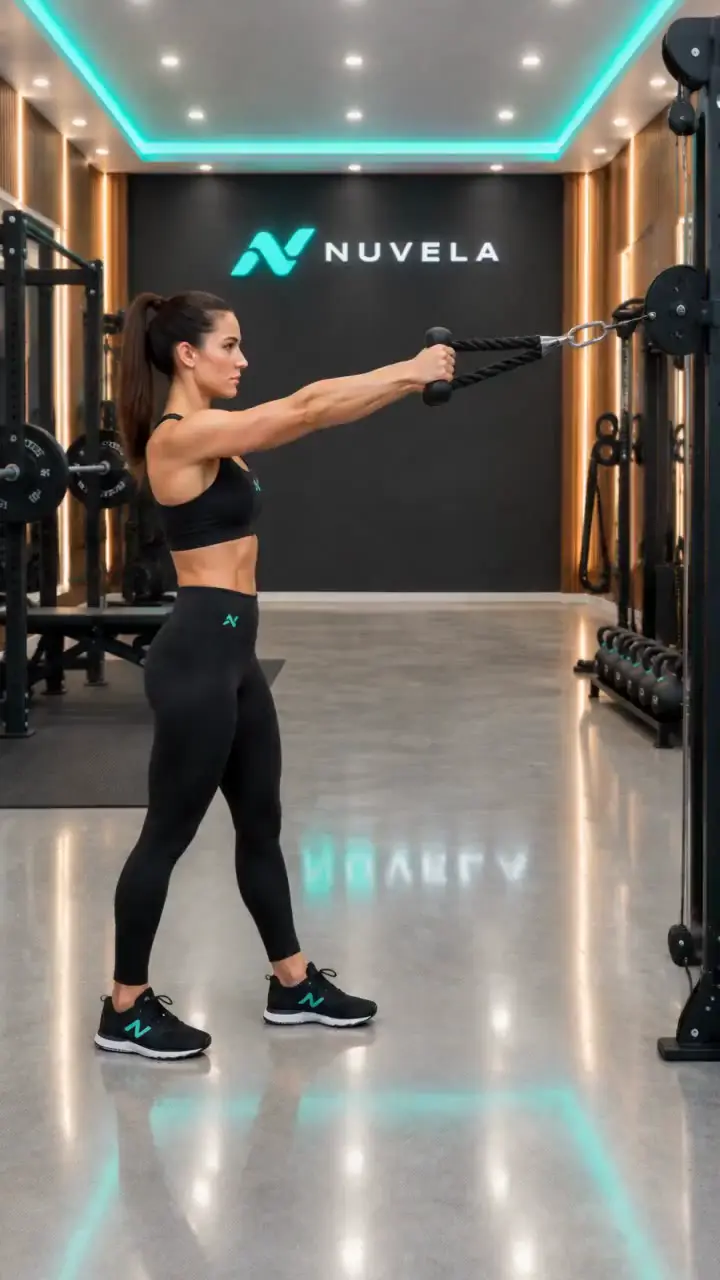
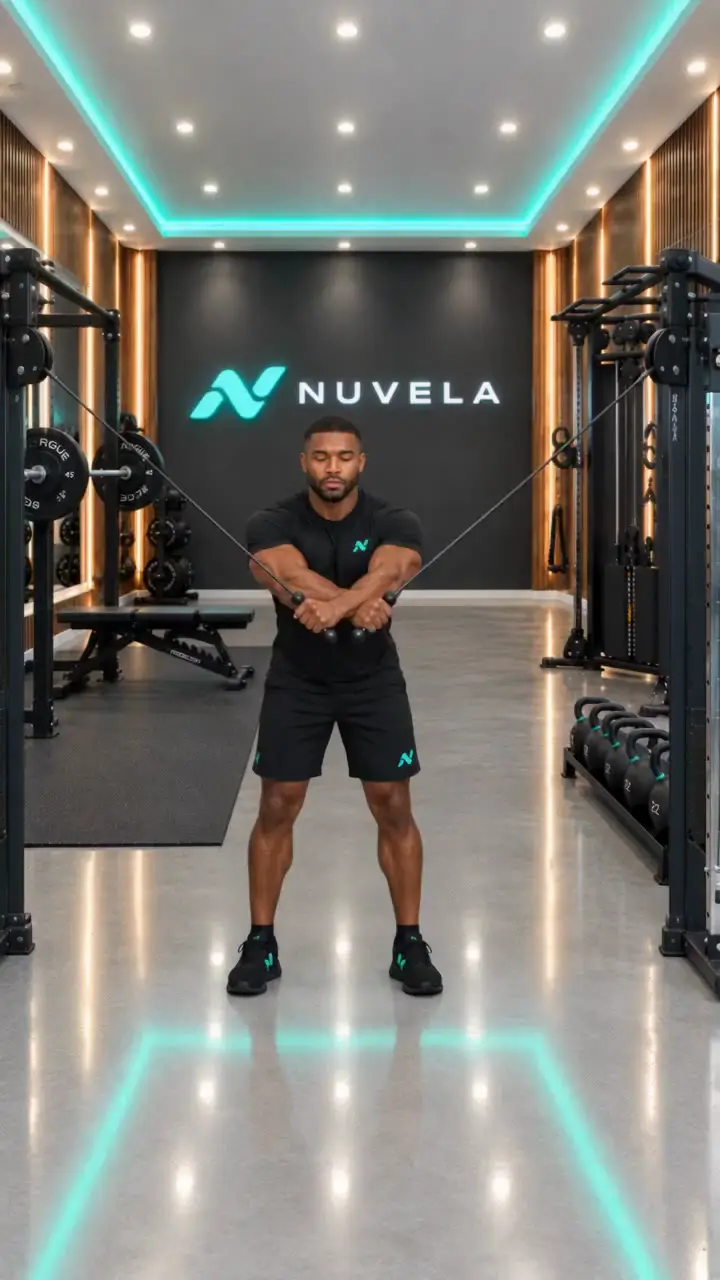
- Face pull: pull the rope toward your eyes and spread the ends apart, thumbs pointing back.
- Close-grip pulldown: lean back slightly, pull the handle to your upper chest, elbows close to your sides.
How often
Once a week gives your back 18 sets. That's past the 10 weekly sets the ACSM review linked to more muscle growth.
Training back twice a week? Split it: moves 1 to 3 on one day, 4 to 6 plus 2 sets of rows on the other. See how many sets per muscle group to set your weekly total.
Get this week built for your gym.
Plan your workout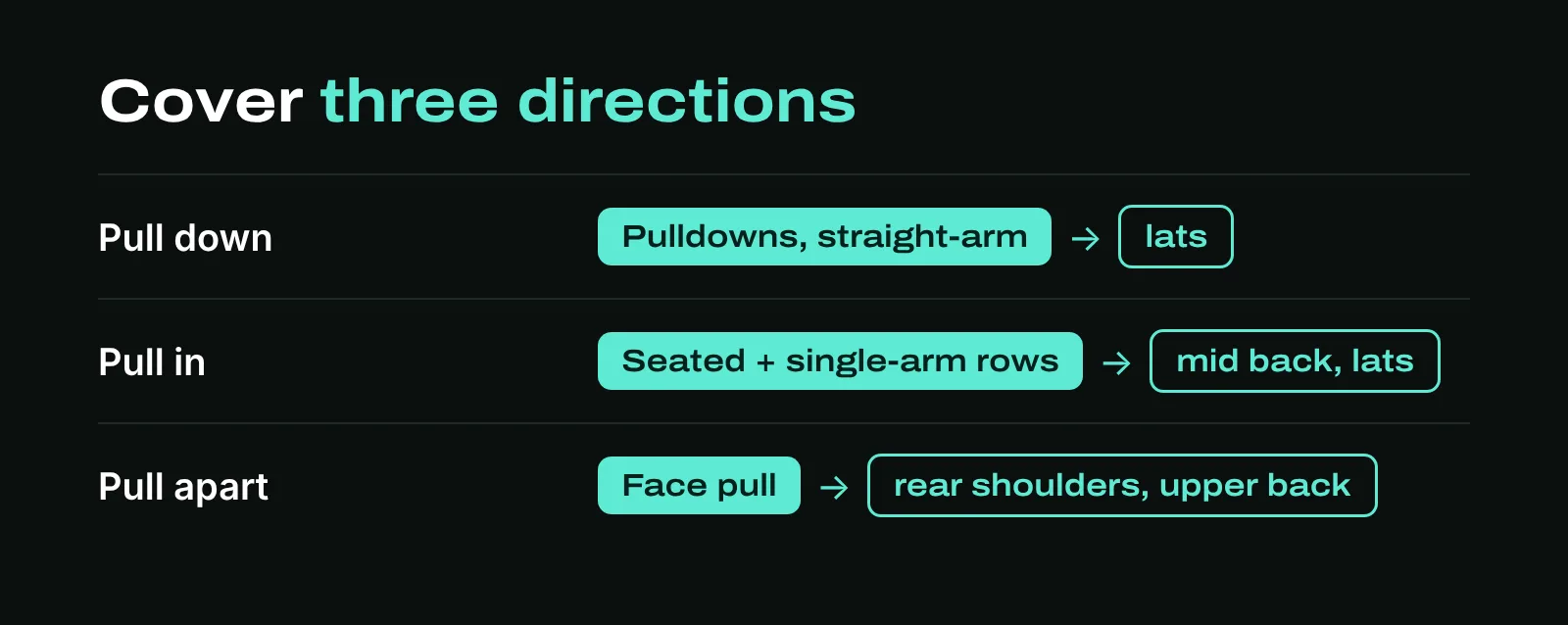
How to pick the weight on cables
Stack numbers vary between machines, so pick by reps.
- First session: choose a plate you could move 2 or 3 more times at the end of each set. Going to failure did not consistently add results in the ACSM review.
- The lean test: if you have to lean back more than a little on pulldowns, or rock your torso on rows, the weight is too heavy. Go down one plate.
- Heavy first, lighter later. Pulldowns and rows at 8 to 12 reps build strength. Straight-arm pulldowns and face pulls work well at 12 to 15: in a 2017 meta-analysis, light loads built as much muscle as heavy ones when sets were hard.
- Moving up: when every set hits the top of the range, add one plate. If the jump is too big, add a rep per set first.
- Same station, same numbers. Log which machine you used so next week compares fairly.
If you know a recent hard set on the pulldown, the one rep max calculator turns it into a starting weight for 8 to 10 reps.
What to do after each session
| Last session | Next session |
|---|---|
| Every set at the top of the range, 2 reps left | Add one plate, often 5 to 10 lb (2 to 5 kg) |
| Inside the range | Same plate, aim for 1 more rep per set |
| Under the range, or you had to lean and yank | Go down one plate |
| The plate jump is too big | Add reps up to the top of the range first, or use a small add-on weight if your gym has one |
Some stations use a different pulley setup, so the same number can feel much lighter or heavier. That's another reason to compare only against the same station.
Swaps when a station is taken
| If you can't do | Swap to | Sets × reps |
|---|---|---|
| Lat pulldown | Assisted pull-up or pull-up | 4 × 6–10 |
| Seated cable row | Chest-supported dumbbell row | 3 × 8–12 |
| Single-arm cable row | One-arm dumbbell row | 3 × 10–12 each |
| Straight-arm pulldown | Dumbbell pullover | 3 × 12–15 |
| Face pull | Band pull-apart or rear-delt dumbbell fly | 3 × 15–20 |
| Close-grip pulldown | Underhand pulldown | 2 × 10–12 |
The ACSM review found equipment type did not consistently change results, so dumbbell swaps work just as well. For a full dumbbell session, see back workouts with dumbbells.
Good
- Cables let you pull from any height and keep tension through the whole rep
- Equipment type did not consistently change results
Keep in mind
- Stack numbers vary between machines, so pick by reps
- Log which machine you used so next week compares fairly
Swaps by equipment and level
| You have or are | Pull down | Pull in | Pull apart |
|---|---|---|---|
| One cable column only | Single-arm pulldown, kneeling | Single-arm row | Face pull |
| No cables, dumbbells | Dumbbell pullover | One-arm dumbbell row, seal row | Rear-delt dumbbell fly |
| Bands at home | Band pulldown from a door anchor | Band row | Band pull-apart |
| Beginner | Lat pulldown, 3 × 10–12 | Seated cable row | Face pull |
| Advanced | Pull-up or chin-up with added weight | Seated row + machine row | Face pull + reverse pec deck |
The three pulling directions, explained
Each direction loads your back from a different angle. One move from each covers the whole back.
| Direction | Cable moves | Main muscles | Sets in this plan |
|---|---|---|---|
| Pull down (from above) | Lat pulldown, close-grip pulldown, straight-arm pulldown | Lats, lower traps | 9 |
| Pull in (from the front) | Seated row, single-arm row | Mid back, rhomboids, lats | 6 |
| Pull apart (at face height) | Face pull | Rear shoulders, upper back | 3 |
Biceps help on every pulldown and row, so a separate biceps move is optional. If you want one, add a cable curl for 2 × 12–15 at the end.
The warm-up: 6 minutes before your first pulldown
- 5 minutes on the rower at an easy pace, or 3 minutes plus 1 minute of arm circles.
- Straight-arm pulldown, 1 × 15 with a light plate, to feel your lats.
- Lat pulldown, 1 × 12 at about half your working weight, then 1 × 5 at about 75%.
Then start your first working set. Later moves need no extra warm-up sets.
Cable back workout variations
Lat focus: 40 minutes
| # | Exercise | Sets × reps | Rest |
|---|---|---|---|
| 1 | Lat pulldown, overhand grip | 4 × 8–10 | 2 min |
| 2 | Single-arm pulldown, kneeling | 3 × 10–12 each | 60 s |
| 3 | Single-arm cable row, low pulley | 3 × 10–12 each | 60 s |
| 4 | Straight-arm pulldown, rope | 3 × 12–15 | 60 s |
Upper back focus: 40 minutes
| # | Exercise | Sets × reps | Rest |
|---|---|---|---|
| 1 | Seated cable row, wide handle | 4 × 8–12 | 2 min |
| 2 | Face pull, rope | 3 × 12–15 | 60 s |
| 3 | Reverse cable fly, pulleys at shoulder height | 3 × 12–15 | 60 s |
| 4 | Close-grip pulldown, neutral handle | 3 × 10–12 | 90 s |
Quick version: 30 minutes
| # | Exercise | Sets × reps | Rest |
|---|---|---|---|
| 1 | Lat pulldown | 3 × 8–10 | 90 s |
| 2 | Seated cable row | 3 × 8–12 | 90 s |
| 3 | Face pull + straight-arm pulldown, back to back | 3 × 12–15 each | 60 s after the pair |
The quick version is 12 sets. Run it twice a week and you're at 24. For fitting sessions into your time, see how long should a workout be.
Lat pulldown grips and cable handles
Grip changes the feel more than the result. Turning your palms forward made the biggest difference in the 2010 study; width did not.
| Handle or grip | Width | What changes | Use it for |
|---|---|---|---|
| Straight bar, overhand | Just outside your shoulders | More lat activity than underhand in the 2010 study | Main pulldown |
| Straight bar, wide overhand | Well past your shoulders | Shorter range, similar lat activity | Variety |
| Straight bar, underhand | Shoulder width | More biceps help | Variety, or chin-up practice |
| Neutral V-handle or close-grip bar | Narrow, palms facing | Longer pull, elbows tight | Close-grip pulldown, seated row |
| Rope | Narrow | Hands can spread at the end | Face pull, straight-arm pulldown |
| Single D-handle | One hand | Pull past your body, more range | Single-arm row and pulldown |
Sample week: where the cable back day fits
| Day | Upper/lower, 4 days | Push pull legs, 6 days |
|---|---|---|
| Mon | Upper: presses + moves 1–3 | Push |
| Tue | Lower | Pull: full cable back session |
| Wed | Rest | Legs |
| Thu | Upper: presses + moves 4–6 | Push |
| Fri | Lower | Pull: quick 30-minute version |
| Sat | Rest or easy cardio | Legs |
| Sun | Rest | Rest |
On an upper lower split, split the six moves across your two upper days. On push pull legs, each pull day gets a full or short version. On a bro split, the whole 18-set session is your back day. To compare all the layouts, see the workout split hub.
The 8-week progression
| Weeks | Sets | Reps left at the end | Goal |
|---|---|---|---|
| 1–2 | 3 per move for moves 1–5, skip move 6: 15 total | 3 | Learn the moves, find a plate for each |
| 3–6 | The full 18 | 2–3 | Add a rep or a plate every session |
| 7 | The full 18 | 1–2 | Hardest week |
| 8 | 2 per move, 12 total | 3+ | Lighter week, same plates |
After 8 weeks, swap two moves: the single-arm row for a landmine row or the close-grip pulldown for a single-arm pulldown. Keep the main pulldown and seated row so you can track them. When you feel run down for more than a week, read deload week.
Common mistakes and fixes
| Mistake | What happens | Fix |
|---|---|---|
| Pulling the bar behind your neck | Shoulders end up in an awkward spot | Pull to your upper chest |
| Leaning way back on pulldowns | It turns into a row, lats do less | Go down one plate, lean back only a little |
| Rocking on seated rows | Your lower back does the work | Sit tall, move only your arms and shoulder blades |
| Short range at the top | You skip the stretched part | Let your arms straighten fully between reps |
| Face pull to the chest | Turns into a row | Pull toward your eyes, spread the rope ends |
| Same handle every week | Same angle every time | Rotate grips every 4 to 8 weeks |
| Comparing different machines | The numbers mean nothing | Log the station you used |
Cable vs dumbbell back workouts
Both build the back; pick by what your gym or home has. The 2026 ACSM review found equipment type did not consistently change results.
| Cables | Dumbbells | |
|---|---|---|
| Pull from above | Yes: pulldowns at any width | Only a pullover |
| Tension at the stretched end | Stays on through the whole rep | Light at the bottom of some rows |
| Weight steps | One plate, often 5 to 10 lb (2 to 5 kg) | One pair up, often 5 lb (2 kg) per hand |
| Setup | Change the handle or pulley height | Grab a pair, find a bench |
| Works at home | Only with a cable machine or bands | Yes |
Good
- Cables: the easiest way to train the pull-down direction without pull-ups
- Dumbbells: one pair covers rows and pullovers at home
Keep in mind
- Cables: busy stations at peak hours
- Dumbbells: no true pulldown, so add pull-ups or bands
Who this cable back workout is for
| You are | How to use it |
|---|---|
| New to lifting | Weeks 1–2 of the progression, 3 sets per move, for 4 weeks |
| Gym regular on a split | Full session on pull or back day |
| Short on time | The 30-minute version, twice a week |
| Can't do pull-ups yet | Pulldowns build the same pattern; add negative pull-ups later |
| Training with a partner | Take turns on the stack; see partner workouts |
Training chest the same week on cables too? Pair it with the cable chest workout.
How Nuvela builds a cable back day
Nuvela builds your week from a few questions: goal, experience, where you train, and how many days and minutes you have. Snap your gear and it reads the photos of your equipment, so cable moves only show up if your gym has them.
- It sets every weight and adjusts it as you log.
- When the pulldown is taken, swap the move.
- A video for every move in your plan.
- Strength, cardio and yoga in one weekly plan, in the mix you choose.
Try the workout planner.
More questions about cable back workouts
Is the seated cable row or the lat pulldown better?
Do both; they pull in different directions. The pulldown pulls from above and leans on the lats; the row pulls from the front and adds the mid back. If you can only do one, alternate them week to week.
How do I make a cable back workout harder without more weight?
Add a rep per set, a one-second pause at your body, or one more set. When the top of the range comes easily on every set, move up one plate.
Common questions
Are cables good for back workouts?
Yes. Cables let you pull from any height and keep tension through the whole rep. The 2026 ACSM review found equipment type did not consistently change results, so a cable-only back day works.
Which cable exercise is best for lats?
The lat pulldown with an overhand grip, followed by the straight-arm pulldown. In the 2010 study, the overhand grip produced more lat activity than an underhand grip.
Should I use a wide or close grip on lat pulldowns?
Either works. In the 2010 study, grip width did not change lat activity, but turning your palms forward did. Use a grip just outside your shoulders and switch now and then for variety.
How many back exercises should I do in one workout?
Four to six, covering pull down, pull in and pull apart. That gives you 12 to 18 hard sets.
Can you build a big back with only cables?
Yes, if you add weight or reps over time and reach at least 10 hard sets a week. Pull in all three directions and log each station so your progress compares fairly.
Sources
- Grip width and forearm orientation effects on muscle activity during the lat pull-down, Journal of Strength and Conditioning Research (2010). 12 men at 70% of 1RM: an overhand (pronated) grip produced more lat activity than an underhand grip, whether the grip was wide or narrow.
- ACSM Position Stand, Resistance Training Prescription for Muscle Function, Hypertrophy, and Physical Performance in Healthy Adults: An Overview of Reviews, Medicine and Science in Sports and Exercise (2026). 137 systematic reviews, more than 30,000 participants: 10 or more sets a week went with more muscle growth; full range of motion and 2 or more sessions a week helped strength; equipment type and training to failure did not consistently change results.
- Strength and Hypertrophy Adaptations Between Low- vs. High-Load Resistance Training: A Systematic Review and Meta-analysis, Journal of Strength and Conditioning Research (2017). 21 studies, sets taken to failure: muscle growth was similar with light and heavy loads; 1RM strength went up more with heavy loads.
Related guides
- Back and Bicep Workout: 7 Moves for One Gym Day
- Back Workouts With Dumbbells: Home and Gym Plan
- How Many Sets per Muscle Group? 10–20 a Week
Exercises in this guide
- Lat pulldown
- Seated cable row
- Straight-arm pulldown
- Face pull
- Rowing machine
- Pull-up
- One-arm dumbbell row
- Dumbbell pullover
- Seal row
- Band row
- Chin-up
- Machine row
- Reverse pec deck
- Cable curl
- Arm circles
- Reverse cable fly
- Landmine row
Try 7 days, no card needed
